|
|
| Brand Name: | CHG |
| Model Number: | PR-PSS-03 |
| MOQ: | 1 set |
| Price: | 100,000-200,000 USD |
| Payment Terms: | T/T,D/P,D/A,L/C |
| Supply Ability: | 10 sets per year |
Industrial Spray Pretreatment System for Metal Powder Coating Production Lines
CHG develops customized spray pretreatment systems for powder coating production lines, providing controlled surface cleaning and chemical treatment before electrostatic powder application.
The system uses circulating chemical solutions delivered through strategically positioned spray nozzles to remove manufacturing residues and prepare metal surfaces for subsequent coating.
Depending on the substrate material and required coating performance, the equipment can incorporate multiple cleaning, rinsing, surface conditioning, and chemical conversion stages.
Each pretreatment system is engineered according to the customer's workpiece characteristics, production capacity, chemical process specifications, and overall coating line layout.
The performance of a powder-coated product depends not only on the coating material and application equipment but also on the condition of the underlying metal surface.
Metal components frequently contain contaminants introduced during manufacturing, transportation, and storage. These may include machining oils, lubricants, grease, dust, and oxidation residues.
Inadequate surface preparation can contribute to coating defects, poor adhesion, and premature corrosion.
A properly designed spray pretreatment system supports:
Effective removal of surface contaminants
Consistent chemical treatment of metal substrates
Improved adhesion between the substrate and powder coating
Enhanced corrosion protection
Reduced risk of contamination-related coating defects
Repeatable surface treatment conditions
The pretreatment process must be compatible with both the substrate material and the selected powder coating specification.
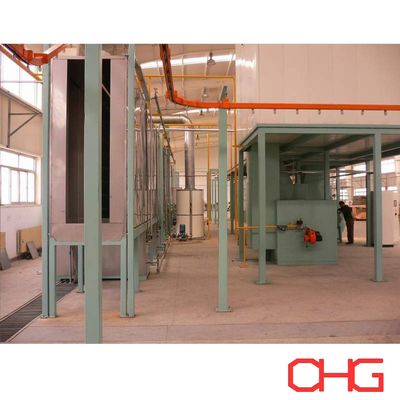
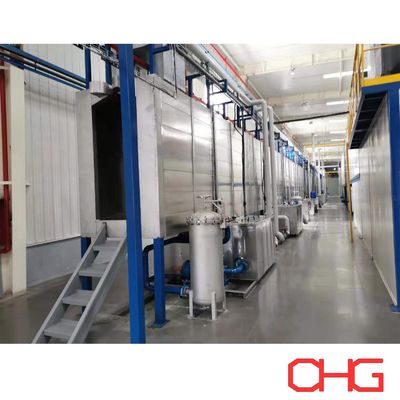
The system consists of interconnected treatment chambers, with each section performing a designated chemical cleaning, rinsing, or conversion treatment function.
The modular arrangement allows the number of processing stages, chamber dimensions, and equipment specifications to be adapted to different industrial applications.
The enclosed spray chambers accommodate suspended or conveyorized metal workpieces during chemical treatment.
Chamber dimensions are determined according to the maximum workpiece envelope, conveyor arrangement, spray coverage requirements, and processing time.
Construction materials are selected according to the chemical composition and operating temperature of each treatment stage.
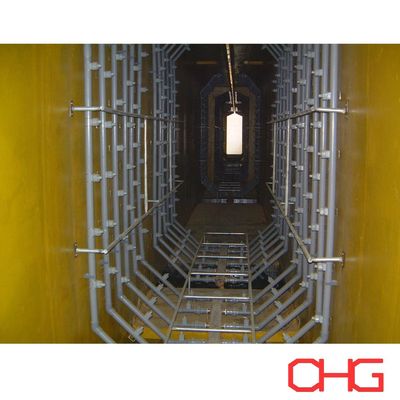
Chemical solutions are distributed through spray pipelines equipped with appropriately positioned nozzles.
Nozzle quantity, spraying angle, flow rate, and operating pressure are designed according to the workpiece geometry and treatment requirements.
The spray arrangement aims to provide adequate solution contact with the specified metal surfaces.
Individual treatment stages are equipped with dedicated solution tanks for chemical storage and circulation.
Tank capacity is calculated according to the required circulation volume, spray flow rate, and process operating conditions.
Tank configurations can incorporate liquid-level monitoring, drainage connections, overflow arrangements, and maintenance access.
Circulation pumps transfer treatment solutions from the tanks to the spray distribution systems.
Pump specifications are selected according to the required flow rate, pressure, chemical compatibility, and operating temperature.
The circulating arrangement allows treatment solutions to be collected and reused within their respective processing stages, subject to chemical bath maintenance requirements.
Certain cleaning and chemical conversion processes require elevated solution temperatures.
Heating systems can be incorporated into the corresponding treatment tanks according to the chemical supplier's operating specifications.
Temperature monitoring and control equipment help maintain the required treatment conditions.
Depending on the selected process, filtration equipment, oil separation systems, and sludge removal arrangements can be incorporated.
These systems help manage contaminants introduced during workpiece cleaning and chemical treatment.
The chemical treatment sequence is determined by the substrate material, initial surface condition, and required coating performance.
A representative multi-stage pretreatment process for steel components may include the following operations.
| Process Stage | Treatment Objective |
|---|---|
| Pre-Degreasing | Remove initial oils and heavy surface contamination |
| Main Degreasing | Provide further cleaning of the metal substrate |
| Water Rinsing | Reduce residual cleaning chemicals |
| Surface Conditioning | Prepare the substrate for subsequent phosphating, where required |
| Phosphating or Conversion Treatment | Develop a suitable chemical conversion layer |
| Post-Treatment Rinsing | Remove residual treatment chemicals |
| Final Rinsing | Reduce remaining contaminants and soluble residues |
| Moisture Drying | Prepare dry workpieces for powder application |
The actual number and sequence of treatment stages may vary according to the selected chemical technology.
The cleaning solution is sprayed onto the workpieces to remove grease, oils, lubricants, and other manufacturing residues.
Cleaning effectiveness depends on chemical concentration, solution temperature, spraying pressure, treatment duration, and contamination levels.
For heavily contaminated components, separate pre-degreasing and main degreasing stages may be incorporated.
Rinsing sections are positioned between appropriate chemical treatment stages to reduce chemical carryover.
Effective rinsing helps maintain the operating conditions of subsequent chemical baths and minimizes unwanted residues on the metal surfaces.
The rinsing system can be configured according to water quality requirements, chemical consumption, and wastewater management considerations.
Surface conditioning may be required before certain phosphating processes, particularly zinc phosphating.
Rather than mechanically roughening the metal, this treatment promotes the formation of a finer and more uniform phosphate crystal structure during the subsequent conversion stage.
Its inclusion depends on the selected chemical process.
Chemical conversion treatment modifies the metal surface to provide a suitable foundation for subsequent powder coating.
For steel components, iron phosphating, zinc phosphating, or alternative conversion technologies may be considered.
For aluminum components, compatible chromate or chrome-free conversion treatments can be selected.
The chemical process must be evaluated according to the substrate, coating adhesion requirements, corrosion resistance specifications, and applicable environmental regulations.
Where required by the chemical process, a final rinsing stage removes remaining treatment residues before moisture drying.
Deionized water rinsing can be incorporated for applications requiring greater control of residual surface contamination.
Some conversion coating technologies may require different final treatment arrangements, depending on the chemical supplier's instructions.
After pretreatment, the workpieces are transferred to the moisture drying section of the coating production line.
Depending on product geometry, compressed-air water blowing may be incorporated before drying to remove retained water from channels, cavities, and recessed areas.
The drying oven removes remaining moisture before the workpieces enter the powder spray booth.
Different metals require compatible chemical treatment processes. CHG configures the equipment according to the selected pretreatment technology rather than applying a universal chemical sequence to every production line.
| Substrate Material | Typical Treatment Options |
|---|---|
| Carbon Steel | Degreasing, iron phosphating, zinc phosphating, or alternative conversion treatment |
| Galvanized Steel | Compatible cleaning and conversion treatment |
| Aluminum Alloys | Degreasing, appropriate etching where required, and chromate or chrome-free conversion treatment |
| Mixed-Metal Components | Compatible multi-metal pretreatment technology |
Final chemical selection and operating parameters should be confirmed with the pretreatment chemical supplier according to the required coating performance.
The equipment can be integrated with different conveyor operating arrangements.
Workpieces travel through the spray chambers at a controlled conveyor speed.
The effective length of each treatment section is calculated according to the required chemical contact time and conveyor speed.
This arrangement is suitable for repetitive manufacturing operations with relatively consistent production flow.
Workpieces stop at designated treatment stations for a predetermined processing period before moving to the next section.
This configuration can be considered for production lines requiring different treatment durations, flexible material handling, or customized station arrangements.
Both configurations can be integrated into a complete powder coating production line.
Stable chemical treatment conditions are important for maintaining consistent surface preparation.
Depending on the process requirements, the pretreatment system can incorporate monitoring and control functions for:
Chemical solution temperature
Tank liquid levels
Circulation pump operation
Spray pressure
Treatment duration
Conveyor movement
Water replenishment
Heating equipment operation
Equipment alarms and interlocks
Chemical concentration, pH, conductivity, and other bath parameters should be monitored according to the selected chemical supplier's specifications.
Automatic monitoring and dosing equipment can be incorporated where required.
The design of a spray pretreatment system must consider both treatment performance and ongoing operating costs.
Depending on the production requirements, CHG can incorporate counterflow rinsing, solution recirculation, filtration, and controlled water replenishment arrangements.
These features can help reduce unnecessary water consumption, chemical losses, and contamination between treatment stages.
Wastewater collection and discharge interfaces can also be coordinated with the customer's wastewater treatment facilities.
CHG spray pretreatment systems can be integrated into powder coating production lines for a wide range of manufactured metal products, including:
Electrical control cabinets and enclosures
Automotive metal components
Aluminum profiles and extrusions
Metal furniture
Industrial storage racks and shelving
HVAC equipment components
Household appliance housings
Agricultural machinery components
Fabricated steel structures
Industrial equipment frames
General sheet metal products
The pretreatment configuration is adapted to the specific material, product geometry, production volume, and coating performance requirements.
| Design Parameter | Available Configuration |
|---|---|
| Treatment Method | Multi-stage chemical spraying |
| Processing Mode | Continuous or intermittent |
| Number of Treatment Stages | Customized |
| Chamber Dimensions | According to workpiece envelope |
| Chamber and Tank Materials | Selected according to chemical compatibility |
| Spray Nozzle Arrangement | Customized |
| Circulation Pump Capacity | Calculated according to process requirements |
| Chemical Solution Heating | Optional |
| Filtration System | Process-specific |
| Oil and Sludge Management | Optional |
| Rinsing Water System | Customized |
| Mist Extraction | According to chemical and operating conditions |
| Conveyor Integration | Project-specific |
| Electrical Control | Customized |
| Production Capacity | According to manufacturing requirements |
The spray pretreatment system is engineered as part of the overall coating production process.
A typical integrated production sequence consists of:
Workpiece Loading → Spray Pretreatment → Moisture Drying → Electrostatic Powder Application → Thermal Curing → Cooling → Inspection and Unloading
CHG coordinates the pretreatment chamber dimensions, conveyor speed, chemical treatment duration, drying capacity, and downstream coating equipment to establish a compatible production flow.
This integrated engineering approach helps avoid capacity mismatches between individual processing sections.
To develop a suitable spray pretreatment configuration, CHG evaluates the following project information:
Workpiece drawings and photographs
Substrate materials
Maximum workpiece dimensions and weight
Initial surface condition and contamination level
Required hourly or daily production capacity
Preferred pretreatment chemical technology
Required chemical treatment sequence
Coating adhesion and corrosion resistance specifications
Available workshop dimensions
Conveyor type and operating speed
Available heating energy
Water supply and water quality
Wastewater treatment requirements
Required automation level
Where the customer already has a designated chemical supplier, the pretreatment equipment can be engineered according to the supplier's recommended treatment parameters.
CHG provides industrial spray pretreatment systems as part of customized powder coating production lines, combining chemical treatment chambers, circulation tanks, spray distribution equipment, pumps, heating systems, and process controls.
From conventional phosphating processes to alternative conversion coating technologies, each system is configured around the customer's substrate materials, chemical specifications, production capacity, and factory conditions.
Contact CHG with your workpiece specifications and surface treatment requirements to receive a customized powder coating production line proposal with an integrated spray pretreatment system.
![]()