|
|
| Brand Name: | CHG |
| Model Number: | AC-05 |
| MOQ: | 1 set |
| Price: | 100,000-300,000 USD |
| Payment Terms: | L/C,D/A,T/T,D/P |
| Supply Ability: | 10 sets per year |
CHG designs and manufactures customized powder coating production lines for electrical control cabinets, enclosure chassis, and fabricated sheet metal components.
This production line accommodates workpieces with different dimensions and structural configurations, combining intermittent processing with continuous powder application. The system features a PP (polypropylene) powder spray booth, automatic electrostatic spray guns, supplementary manual spraying stations, and a monorail overhead conveyor system.
Elevator-assisted loading and unloading stations facilitate manual workpiece handling, while designated accumulation areas coordinate the drying, curing, and cooling operations.
The production line is particularly suitable for electrical equipment manufacturers requiring flexible processing arrangements for multiple sheet metal product types.
| Item | Configuration |
|---|---|
| Application | Electrical control cabinet chassis and sheet metal parts |
| Conveyor Type | Monorail overhead conveyor |
| Loading Method | Elevator-assisted manual loading |
| Unloading Method | Elevator-assisted manual unloading |
| Pretreatment Method | Intermittent spray treatment |
| Moisture Drying | Accumulation-type drying arrangement |
| Spray Booth Material | PP (polypropylene) |
| Powder Application | Automatic spraying and supplementary manual coating |
| Manual Spray Room | Stop-and-spray operation |
| Automatic Spraying Speed | 1.0–1.5 m/min |
| Powder Curing | Angled workpiece accumulation arrangement |
| Cooling Method | Natural cooling |
| Finished Product Transfer | Transportation to assembly area |
| Equipment Layout | Customized |
The above configuration represents a specific production line design. Equipment dimensions, conveyor capacity, and operating parameters can be modified according to individual project requirements.
Unlike conventional coating lines operating at a single continuous conveyor speed, this configuration combines stationary processing, continuous transportation, and workpiece accumulation at different production stages.
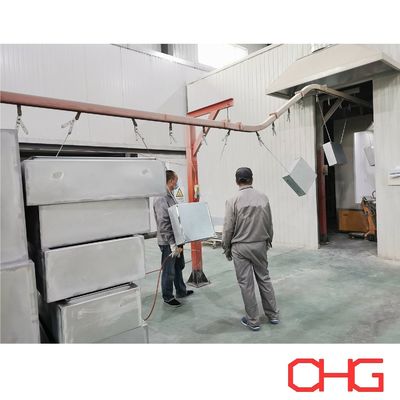
At the loading station, the conveyor hanger stops at a designated position, and the lifting mechanism lowers it to a suitable working height.
Operators manually attach sheet metal components to the hangers. Once loading is completed, the elevator raises the workpieces to the conveyor transportation level.
This arrangement improves accessibility when handling cabinet chassis, enclosure panels, and components with different hanging requirements.
The suspended workpieces move through the pretreatment stations in sequence.
At each designated processing position, the components temporarily stop for spray cleaning or chemical treatment.
This intermittent transportation method allows individual treatment stages to operate according to their required processing times.
The pretreatment sequence can be configured according to the sheet metal material, surface condition, and required corrosion resistance.
Following pretreatment, the workpieces are transferred into the moisture drying section.
Multiple suspended components can be arranged within the designated drying area, allowing the equipment to accommodate the required drying residence time.
Residual moisture is removed from flat surfaces, folded edges, welded joints, and recessed sections before powder application.
Before entering the automatic spray booth, the workpieces pass through a separate manual spraying room.
The conveyor temporarily stops, allowing operators to concentrate on surfaces that may be difficult to reach during automatic spraying.
This preliminary manual coating operation is particularly useful for electrical cabinet components containing internal corners, folded structures, reinforcement sections, and recessed surfaces.
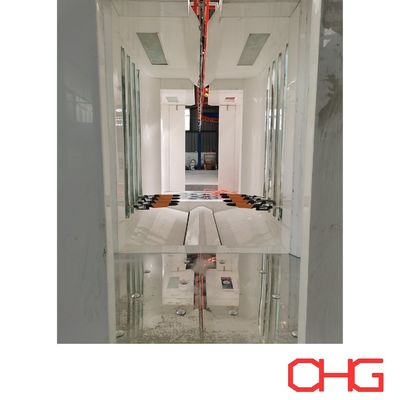
The workpieces subsequently enter the PP automatic powder spray booth, where they travel continuously at a conveyor speed of 1.0–1.5 meters per minute.
Automatic electrostatic spray guns perform the main coating operation, with supplementary manual spraying available where additional coverage is required.
The combination of stationary manual pre-spraying and continuous automatic application provides flexibility for processing sheet metal parts with different geometries.
After powder application, the suspended components are transferred to the curing section.
The workpieces are arranged at an angle within the accumulation area to make effective use of the available curing space.
The hanging orientation and spacing must be designed to prevent contact between freshly coated components while maintaining suitable hot-air circulation.
The curing residence time is determined according to the powder coating specification and the thermal characteristics of the workpieces.
After leaving the curing oven, the coated components enter a designated natural cooling area.
The workpieces remain suspended while their temperature gradually decreases.
This arrangement allows the products to reach a suitable handling temperature without requiring a dedicated forced-air cooling system in this configuration.
Once sufficiently cooled, the finished components are transported toward the assembly area.
Integrating the coating line with downstream manufacturing operations can reduce intermediate handling and simplify the movement of finished sheet metal parts.
At the final unloading station, the lifting mechanism lowers the suspended components to an accessible working height.
Operators manually remove the finished products for inspection, assembly, packaging, or storage.
| Processing Stage | Workpiece Movement |
|---|---|
| Loading | Stationary, elevator-assisted |
| Spray Pretreatment | Intermittent movement with station stops |
| Moisture Drying | Accumulation |
| Manual Pre-Spraying | Stationary |
| Automatic Powder Spraying | Continuous at 1.0–1.5 m/min |
| Powder Curing | Angled accumulation |
| Natural Cooling | Stationary |
| Assembly Area Transfer | Conveyor transportation |
| Unloading | Stationary, elevator-assisted |
Electrical enclosures and control cabinet chassis are commonly manufactured through cutting, bending, stamping, welding, and other sheet metal fabrication processes.
These operations may leave processing oils, lubricants, dust, and other contaminants on the metal surfaces.
A properly selected pretreatment process prepares the substrate for powder application and supports the required coating adhesion and corrosion protection.
Depending on the workpiece material, the pretreatment system may incorporate:
Pre-degreasing
Main degreasing
Water rinsing
Chemical conversion treatment
Final rinsing
Moisture removal
For carbon steel components, phosphate or alternative conversion coating processes may be considered. For aluminum sheet metal parts, compatible chromate or chrome-free conversion treatments can be selected.
The chemical sequence and operating parameters are established according to the customer's substrate materials and finished product requirements.
The automatic spraying section features a booth constructed from polypropylene.
PP provides good resistance to many chemicals and offers a surface suitable for routine cleaning and powder removal.
The booth is designed around the maximum workpiece envelope, conveyor openings, automatic gun positions, manual spraying access, and powder extraction requirements.
Electrical cabinet components often contain structural features that make powder application more challenging than coating simple flat panels.
These may include:
Folded sheet metal edges
Internal cabinet corners
Recessed mounting sections
Reinforcement channels
Door frame structures
Welded connections
Equipment mounting brackets
Electrostatic shielding and the Faraday cage effect can reduce powder deposition in certain recessed areas.
The dedicated manual pre-spraying room allows operators to address these locations before the main automatic coating operation.
Automatic spray guns then apply powder to the broader accessible surfaces as the workpieces travel through the booth.
Additional manual spraying can be incorporated according to the required coating coverage.
The spray booth can be integrated with suitable powder extraction and recovery equipment.
The recovery configuration is selected according to the number of coating colors, powder consumption, production capacity, and color-change frequency.
Cyclone separation or cartridge filtration systems can be considered according to the project requirements.
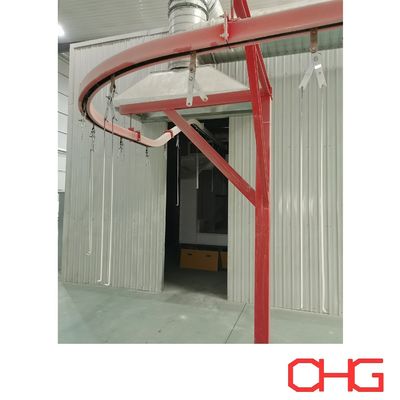
The monorail overhead conveyor connects the processing equipment and supports the movement of suspended sheet metal components throughout the production line.
Its transportation and control arrangement is designed to accommodate different operating modes at individual stations.
The conveyor engineering considers:
Maximum cabinet and panel dimensions
Maximum suspended workpiece weight
Hanger spacing and orientation
Loading and unloading heights
Intermittent processing times
Continuous spraying speed
Drying and curing accumulation capacity
Cooling residence time
Connection to downstream assembly operations
The specified spraying speed of 1.0–1.5 m/min applies to the automatic powder application section. The overall production throughput must be calculated by considering hanger loading density, station processing times, and the capacity of the drying and curing sections.
The production line incorporates separate thermal processing stages for moisture removal and powder curing.
The drying oven removes water remaining after chemical pretreatment, while the curing oven develops the final properties of the applied powder coating.
During curing, the powder melts and flows across the metal surface. Thermosetting powder materials subsequently undergo chemical cross-linking to form a hardened coating film.
The curing oven design takes into account the different thermal characteristics of cabinet panels, welded chassis, mounting plates, and other sheet metal assemblies.
Curing conditions are established according to the required workpiece metal temperature and the powder manufacturer's specified curing schedule.
Electrical control cabinets generally require both protective coating performance and a consistent decorative appearance.
After curing and cooling, finished components can be inspected for:
Coating thickness
Surface smoothness
Color consistency
Gloss level
Adhesion
Edge and corner coverage
Visible coating defects
Curing performance
Additional corrosion resistance and mechanical performance tests can be conducted according to the customer's technical specifications.
Customized hangers and elevator-assisted handling accommodate sheet metal parts with different dimensions and structural designs.
A separate manual spraying room provides additional application flexibility for recessed and difficult-to-reach surfaces before automatic coating.
The automatic spray booth operates at a controlled transportation speed, supporting repeatable coating application on suitable workpieces.
Different transportation modes allow pretreatment, spraying, drying, curing, and cooling operations to be coordinated according to their respective processing requirements.
Finished components can be transported directly toward the assembly area, reducing unnecessary intermediate transfers.
The conveyor routing, equipment dimensions, accumulation areas, and loading stations are engineered around the customer's factory layout and production requirements.
This coating line configuration can be adapted for manufacturers producing:
Electrical control cabinet chassis
Electrical distribution cabinets
Switchgear enclosures
Industrial automation cabinets
Power distribution boxes
Electrical equipment housings
Server and communication cabinets
Sheet metal doors and side panels
Internal mounting plates
Industrial control console housings
Fabricated metal equipment enclosures
CHG develops complete powder coating production lines based on actual manufacturing requirements rather than fixed equipment specifications.
To prepare a detailed technical proposal and accurate quotation, the following information is required:
| Required Information | Engineering Purpose |
|---|---|
| Workpiece Drawings and Photographs | Evaluate product geometry and coating accessibility |
| Maximum Workpiece Dimensions | Determine equipment openings and processing space |
| Maximum Workpiece Weight | Calculate conveyor and lifting equipment capacity |
| Substrate Materials | Select suitable pretreatment processes |
| Required Production Capacity | Establish conveyor speed and processing capacity |
| Product Types and Dimensions | Develop appropriate hanging arrangements |
| Coating Thickness Requirements | Configure powder application equipment |
| Number of Colors | Determine powder recovery and color management requirements |
| Powder Curing Specifications | Calculate curing oven capacity |
| Workshop Dimensions and Clear Height | Develop the overall equipment layout |
| Available Energy Sources | Select suitable heating systems |
| Assembly Area Location | Coordinate finished product transportation |
CHG supplies integrated surface finishing systems for electrical equipment manufacturers and sheet metal fabrication facilities.
This production line combines elevator-assisted material handling, intermittent spray pretreatment, stationary manual pre-spraying, continuous automatic powder application, a PP spray booth, and a monorail overhead conveyor.
The combination of different processing and transportation modes provides a flexible engineering solution for electrical cabinet manufacturers with diverse product dimensions and coating requirements.
Contact CHG with your sheet metal product specifications, production targets, and workshop layout to receive a customized powder coating production line design and quotation.