|
|
| Brand Name: | CHG |
| Model Number: | AC-22 |
| MOQ: | 1 set |
| Price: | 100,000-300,000 USD |
| Payment Terms: | L/C,D/A,D/P,T/T |
| Supply Ability: | 10 sets per year |
Customized Automatic Powder Coating Line with Conveyor System for Metal Parts
CHG designs and supplies automatic powder coating production lines with conveyor systems for manufacturers seeking efficient and repeatable surface finishing of metal components.
The production line can be engineered to accommodate workpieces of different sizes, weights, and geometries, including aluminum profiles, fabricated steel parts, machinery components, and other suitable conductive metal products.
By integrating surface pretreatment, electrostatic powder spraying, thermal curing, and conveyorized transportation, the system provides a coordinated solution for industrial coating operations.
Every CHG powder coating line is developed around the customer's actual products, production targets, coating requirements, and factory conditions.
A complete powder coating system consists of several interconnected processing sections.
| Equipment | Main Function |
|---|---|
| Loading Station | Position workpieces onto the conveyor |
| Conveyor System | Transport metal components between production stages |
| Surface Pretreatment Equipment | Remove contaminants and prepare metal surfaces |
| Drying Oven | Eliminate residual moisture |
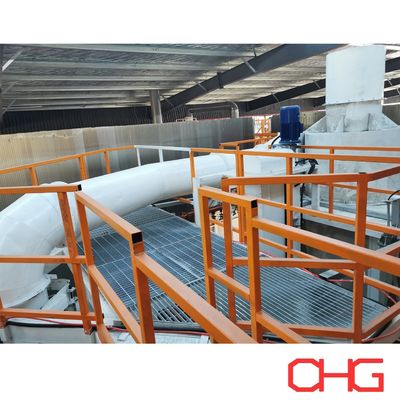
| Powder Spray Booth | Provide an enclosed powder application area |
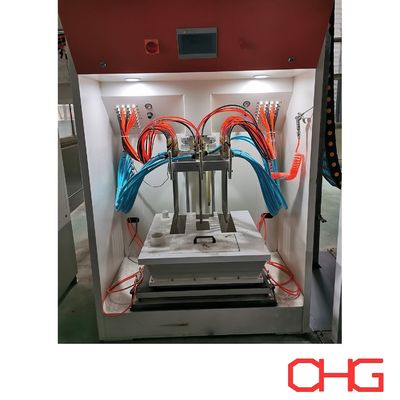
| Automatic Electrostatic Spray Guns | Apply powder coating to metal surfaces |
| Powder Recovery System | Collect oversprayed powder |
| Curing Oven | Thermally cure the applied powder |
| Cooling Section | Reduce workpiece temperature after curing |
| Inspection Station | Verify coating quality |
| Unloading Station | Remove finished components |
| Electrical Control System | Coordinate equipment and production operations |
The final equipment scope and layout are selected according to the required coating process.
The conveyor system connects the main production stages and provides controlled transportation of workpieces.
Depending on the product dimensions, weight, production capacity, and workshop conditions, the conveyor arrangement can be customized to suit the manufacturing process.
Important engineering parameters include:
Maximum workpiece dimensions
Individual workpiece weight
Number of components per hanger or carrier
Required production capacity
Conveyor speed
Workpiece spacing
Factory clear height
Loading and unloading arrangements
Curing residence time
For suspended metal components, customized hangers can be designed to maintain suitable workpiece positioning and coating accessibility.
The conveyor layout is coordinated with the pretreatment equipment, spray booth, curing oven, and available factory space.
The powder application section uses electrostatic spray equipment to deposit powder onto grounded metal surfaces.
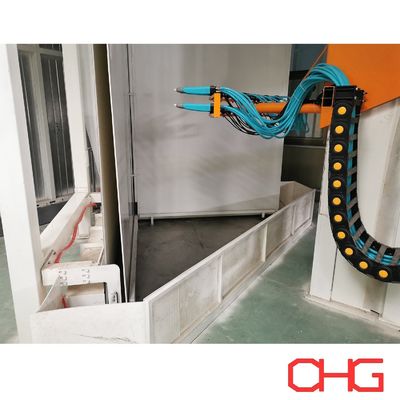
Automatic spray guns can be arranged according to the workpiece geometry and required coating coverage.
Depending on the project, the spraying system may incorporate:
Automatic electrostatic powder guns
Vertical reciprocators
Powder feeding equipment
Spray gun controllers
Manual touch-up stations
Powder extraction equipment
Powder recovery systems
The number and positioning of spray guns are determined according to the product dimensions, conveyor speed, and coating specifications.
For workpieces with complicated geometries, additional spraying positions or manual touch-up may be considered.
A typical automatic powder coating process follows this sequence:
Loading → Surface Cleaning → Chemical Pretreatment → Moisture Drying → Electrostatic Powder Spraying → Thermal Curing → Cooling → Inspection → Unloading
The exact process arrangement depends on the substrate material, coating type, and required finished product performance.
Before coating, metal workpieces must be cleaned to remove oils, grease, dust, and other contaminants.
The cleaning method is selected according to the workpiece material and initial surface condition.
For fabricated steel components, cleaning may include chemical degreasing or other suitable surface preparation methods.
Aluminum products require cleaning processes compatible with the aluminum alloy and subsequent pretreatment chemistry.
After cleaning, the workpieces undergo appropriate chemical surface treatment.
Pretreatment helps prepare the substrate for powder coating and supports the required adhesion and corrosion resistance.
For steel components, phosphate or alternative conversion coating systems may be used.
For aluminum profiles and fabricated aluminum parts, chromate or chrome-free conversion treatment may be appropriate.
The pretreatment system can be designed as a spray or immersion arrangement according to the product characteristics and production requirements.
Following pretreatment and rinsing, the workpieces enter the drying section.
The drying oven removes residual water before powder application.
Drying temperature and residence time are determined according to the workpiece dimensions, material thickness, and conveyor speed.
Proper drying helps reduce coating defects associated with retained moisture.
The prepared metal components enter the powder spray booth.
Automatic electrostatic spray guns apply charged powder particles to the grounded workpiece surfaces.
The powder forms a deposited layer before the workpieces enter the curing oven.
Spraying parameters are adjusted according to the powder material, required film thickness, and workpiece geometry.
After spraying, the conveyor transfers the coated workpieces into the curing oven.
During controlled heating, the powder melts and flows to form a continuous coating film.
For thermosetting powder coatings, chemical cross-linking develops the specified coating properties.
The curing process is designed according to the powder manufacturer's requirements, particularly the required metal temperature and curing time.
After curing, the workpieces move into the cooling section.
Natural or forced-air cooling can be selected according to the production capacity and workpiece characteristics.
The components are cooled to a suitable temperature before unloading and further handling.
Finished products are inspected according to the customer's coating specifications.
Typical inspection items include:
Dry film thickness
Surface appearance
Color consistency
Coating adhesion
Gloss level
Coating coverage
Visible surface defects
Additional testing may be required according to the intended application and applicable quality standards.
The spray booth provides an enclosed area for electrostatic powder application.
Booth dimensions and construction materials are selected according to the product envelope, spraying configuration, and production requirements.
The powder recovery system collects oversprayed powder and supports suitable operating conditions within the booth.
Depending on the application, the recovery arrangement may include cyclone separation, cartridge filtration, or other suitable collection equipment.
The system is selected according to:
Powder characteristics
Production capacity
Number of coating colors
Color-change frequency
Spray booth dimensions
Required coating quality
Powder reuse requirements
Recovered powder may be reused when compatible with the powder manufacturer's recommendations and the customer's quality standards.
The curing oven is an essential part of the powder coating production line.
Its design must account for the workpiece material, dimensions, weight, and required curing conditions.
Important engineering factors include:
Required metal temperature
Powder curing specification
Conveyor speed
Workpiece loading density
Oven residence time
Heating energy
Air circulation
Temperature uniformity
Thermal insulation
The oven configuration is developed to support the required curing conditions for the selected coating material.
For production involving workpieces with different metal thicknesses, curing performance should be evaluated according to the actual product characteristics.
Automatic spraying equipment supports consistent application sequences for suitable workpiece geometries.
The conveyor system connects the main processing stages and reduces repeated manual transfer of components.
Equipment dimensions, conveyor arrangements, and spray gun positions can be customized according to the workpiece characteristics.
Pretreatment, spraying, curing, and cooling equipment can be integrated into a complete production system.
Suitable extraction and recovery equipment can help manage powder consumption and collect oversprayed material.
The production line layout is developed according to the available workshop space, required production output, and material handling conditions.
The automatic powder coating line can be customized for a wide range of metal products, including:
Aluminum profiles and extrusions
Electrical cabinets and enclosures
Metal furniture components
Machinery frames
Fabricated steel structures
Storage racks and shelving
Automotive metal components
Industrial equipment housings
Metal brackets and supports
General manufactured metal products
The final equipment configuration depends on the product dimensions, substrate material, coating requirements, and production volume.
| Parameter | Available Configuration |
|---|---|
| Coating Method | Automatic electrostatic powder spraying |
| Workpiece Material | Steel, aluminum, and other suitable conductive metals |
| Workpiece Dimensions | Customized |
| Maximum Workpiece Weight | According to conveyor design |
| Conveyor System | Selected according to product and production requirements |
| Loading and Unloading | Project-specific |
| Pretreatment | According to substrate and coating specification |
| Spray Booth | Customized |
| Spray Gun Arrangement | According to workpiece geometry |
| Powder Recovery | Selected according to operating requirements |
| Drying | Integrated moisture drying |
| Curing | Powder curing oven |
| Cooling | Natural or forced-air |
| Production Capacity | Customized |
| Control System | Project-specific |
| Workshop Layout | Custom-engineered |
CHG develops each powder coating production line according to the customer's manufacturing conditions.
To prepare a preliminary technical proposal and quotation, please provide:
Workpiece drawings or photographs
Product material
Maximum length, width, and height
Maximum individual workpiece weight
Required hourly or daily production capacity
Number of components per hanger
Powder coating type
Required coating thickness
Number of coating colors
Color-change frequency
Surface pretreatment requirements
Available workshop dimensions
Factory clear height
Heating energy and electrical supply
Required automation level
These details allow the engineering team to evaluate the conveyor configuration, pretreatment process, spraying equipment, powder recovery system, curing oven, and overall production line arrangement.
CHG provides integrated powder coating production lines for industrial manufacturers requiring customized surface finishing equipment.
Our systems combine conveyorized material handling, surface pretreatment, automatic electrostatic spraying, powder recovery, thermal curing, and cooling into a coordinated production process.
Each solution is engineered according to the customer's product specifications, coating requirements, production capacity, and factory conditions.
Contact CHG with your workpiece specifications and production requirements to receive a customized automatic powder coating line proposal and quotation.