|
|
| Brand Name: | CHG |
| Model Number: | AC-28 |
| MOQ: | 1 set |
| Price: | 100,000-300,000 USD |
| Payment Terms: | T/T,D/P,D/A,L/C |
| Supply Ability: | 10 sets per year |
Aluminum Extrusion Powder Coating Production Line with Overhead Conveyor
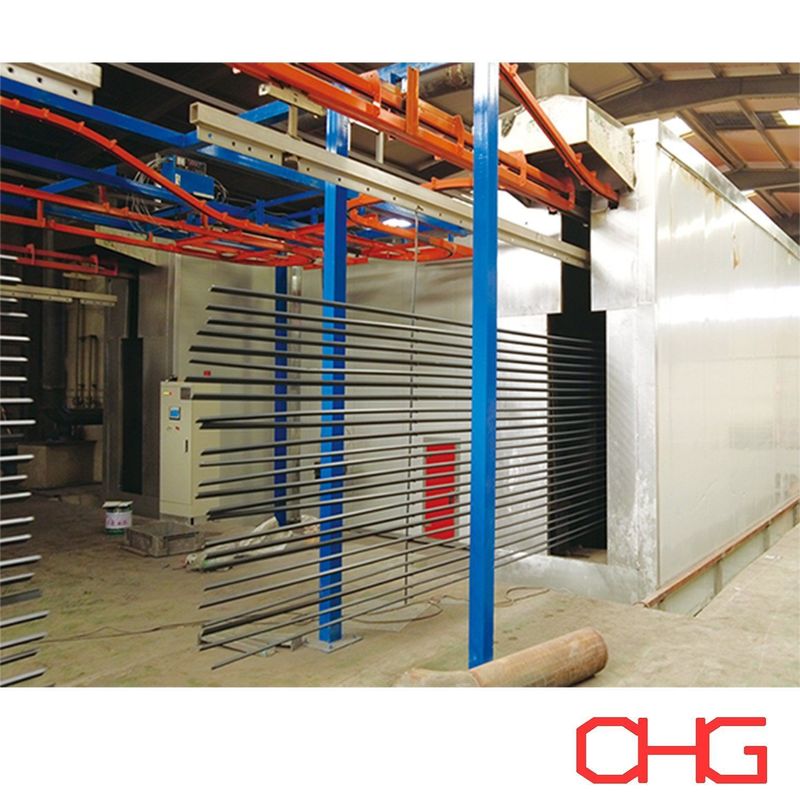
CHG provides customized aluminum extrusion powder coating lines for manufacturers requiring an integrated solution for surface preparation, electrostatic powder application, and thermal curing.
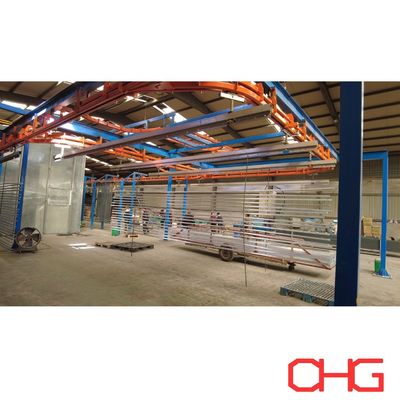
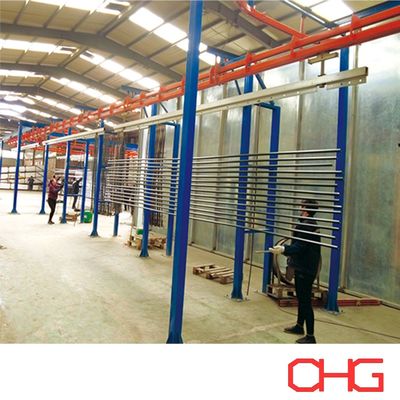
Designed to process aluminum profiles of different lengths and cross-sectional shapes, this production line uses an overhead conveyor to transport suspended workpieces through the coating stages. Manual loading and unloading stations allow operators to handle different profile configurations and adjust hanging arrangements according to the product.
The equipment is engineered around the customer's production capacity, aluminum profile dimensions, coating specifications, and factory layout.
From chemical pretreatment to final inspection, the system brings the essential finishing operations together in a coordinated production process.
Aluminum extrusion manufacturers often produce a wide range of products, including window frames, architectural profiles, structural sections, and industrial components.
These products may differ in length, wall thickness, cross-sectional geometry, and required surface finish.
A suitable powder coating line must account for these variations when determining conveyor spacing, workpiece orientation, spray gun arrangement, and curing conditions.
CHG develops the production line configuration according to the actual products rather than applying identical equipment dimensions to every project.
Maximum aluminum profile length
Profile width and cross-sectional shape
Individual workpiece weight
Required production capacity
Hanging orientation and spacing
Coating thickness specifications
Pretreatment requirements
Number of coating colors
Available workshop dimensions
Heating energy and electrical supply
These parameters form the basis for equipment selection and production line layout development.
The overhead conveyor connects the main processing sections and transports aluminum profiles through the production line.
Workpieces are suspended from customized hangers, allowing the required surfaces to remain accessible during treatment and spraying.
The conveyor is designed according to the profile dimensions, hanging arrangement, and required production throughput.
Important engineering factors include carrier spacing, track routing, conveyor speed, load capacity, and factory clear height.
For long aluminum extrusions, the hanging arrangement must also consider workpiece stability and potential movement during transportation.
Operators position aluminum profiles onto the conveyor hangers at the loading station.
Manual loading allows the hanging arrangement to be adjusted for different product shapes and production batches.
Suitable fixtures can be designed to support the profiles and maintain appropriate spacing between adjacent workpieces.
After curing and cooling, finished aluminum profiles are removed from the conveyor.
The unloading area is arranged to provide suitable access for operators and facilitate transfer to inspection, packaging, or subsequent manufacturing operations.
| Equipment | Function |
|---|---|
| Loading Station | Manual hanging of aluminum profiles |
| Overhead Conveyor | Transportation between production stages |
| Surface Cleaning System | Removal of oils and contaminants |
| Chemical Pretreatment System | Preparation of aluminum surfaces for coating |
| Rinsing Equipment | Removal of chemical residues |
| Drying Oven | Elimination of residual moisture |
| Powder Spray Booth | Enclosed electrostatic powder application |
| Powder Spraying Equipment | Application of powder to grounded aluminum surfaces |
| Powder Recovery System | Collection of oversprayed powder |
| Curing Oven | Thermal curing of the coating |
| Cooling Section | Cooling of finished profiles |
| Inspection Area | Verification of coating quality |
| Unloading Station | Manual removal of coated products |
| Control System | Coordination of equipment operation |
The equipment arrangement can be adapted according to the customer's process requirements and available factory space.
The typical process follows this sequence:
Manual Loading → Cleaning → Chemical Pretreatment → Rinsing → Drying → Electrostatic Powder Spraying → Curing → Cooling → Quality Inspection → Manual Unloading
Aluminum profiles may contain oils, lubricants, dust, and residues from extrusion, machining, or other fabrication operations.
Before coating, these contaminants must be removed to prepare the metal surfaces for chemical pretreatment.
Cleaning equipment and operating conditions are selected according to the type and amount of contamination.
Depending on the production requirements, the cleaning process may use spray treatment or immersion.
Following cleaning, the profiles undergo chemical conversion treatment.
This stage prepares the aluminum surface for powder application and supports the required coating adhesion and corrosion resistance.
Suitable pretreatment technologies may include chromate or chrome-free conversion coatings, depending on the substrate and coating performance requirements.
The chemical process is selected according to the aluminum alloy, intended application, and applicable quality standards.
Rinsing stages are incorporated as required to remove residual treatment chemicals.
After pretreatment and rinsing, the profiles enter the drying oven.
This section removes water remaining on the surfaces and within channels or recessed areas.
Drying conditions are determined according to the profile geometry, material thickness, conveyor speed, and production capacity.
The workpieces must be sufficiently dry before entering the powder application section.
The prepared aluminum profiles enter the spray booth, where electrostatic powder guns apply the selected coating material.
Charged powder particles are attracted to the grounded aluminum surfaces, forming a layer of powder before curing.
The spray gun arrangement is designed according to the profile cross-section and required coating coverage.
For profiles with complicated geometries, gun angles, spraying distances, and application parameters may require additional adjustment.
Depending on the project, the spraying section can incorporate automatic guns, reciprocators, and manual touch-up equipment.
After powder application, the conveyor transports the coated profiles into the curing oven.
During heating, the powder melts and flows to form a continuous film.
For thermosetting powder coatings, the curing reaction develops the specified mechanical and protective properties.
Oven temperature and residence time are determined according to the powder manufacturer's recommendations and the required metal temperature.
The curing system must account for differences in profile wall thickness, loading density, and conveyor speed.
Following curing, the coated aluminum profiles enter a cooling area.
Natural or forced-air cooling may be selected according to the production capacity and available workshop space.
The profiles are cooled to a suitable temperature before unloading and further handling.
Finished products are inspected according to the customer's coating requirements.
Typical inspection items include:
Dry film thickness
Surface appearance
Color consistency
Gloss level
Coating adhesion
Visible surface defects
Coating coverage
Additional testing may be required for architectural or industrial applications with specific performance standards.
Aluminum profiles often contain channels, edges, grooves, and other features that influence powder deposition.
The spray equipment must therefore be arranged according to the actual cross-sectional geometry.
Gun quantity and installation positions are selected to provide suitable coverage of the specified surfaces.
For automatic spraying systems, reciprocator movement and conveyor speed are coordinated with the application process.
Effective electrical grounding is important for electrostatic powder application.
Hangers and contact points must be maintained to support stable powder deposition.
Powder delivery, spray gun settings, application distance, and workpiece movement are adjusted according to the required film thickness.
The finished coating is verified through appropriate inspection procedures.
The spray booth can be connected to a powder recovery system designed to collect oversprayed material.
Depending on the application, the recovery arrangement may include cyclone separation, cartridge filtration, or other suitable collection equipment.
Recovery equipment is selected according to the powder characteristics, production capacity, and number of colors.
For manufacturers producing multiple colors, the spray booth design should also consider cleaning accessibility and color-change procedures.
Recovered powder may be reused when compatible with the coating manufacturer's recommendations and the required quality standards.
The production line can be customized for a variety of aluminum products, including:
Aluminum window profiles
Door frame extrusions
Curtain wall profiles
Architectural aluminum sections
Aluminum partition components
Decorative aluminum profiles
Industrial aluminum extrusions
Aluminum furniture components
Aluminum support frames
General fabricated aluminum products
The appropriate equipment configuration depends on the product dimensions, production volume, and required coating performance.
The conveyor and hanging system can be engineered for aluminum extrusions with different lengths, cross-sections, and weights.
Cleaning, pretreatment, drying, spraying, curing, and cooling can be connected within a complete production line.
Manual handling allows operators to accommodate different profile types and hanging arrangements.
The chemical treatment system is selected according to the aluminum substrate and required coating performance.
Conveyor speed, hanger spacing, and curing residence time are calculated according to the required production capacity.
Equipment dimensions and conveyor routing are developed according to the available workshop space and material flow.
| Parameter | Customization |
|---|---|
| Product Type | Aluminum profiles and extrusions |
| Maximum Workpiece Length | According to customer requirements |
| Maximum Workpiece Weight | Based on conveyor and hanger design |
| Conveyor | Overhead conveyor system |
| Loading | Manual |
| Unloading | Manual |
| Surface Treatment | Cleaning and aluminum chemical conversion treatment |
| Powder Application | Electrostatic powder spraying |
| Spray Booth | Customized dimensions |
| Powder Recovery | According to production requirements |
| Drying | Integrated drying oven |
| Curing | Powder curing oven |
| Cooling | Natural or forced-air |
| Production Capacity | Customized |
| Automation Level | Project-specific |
| Workshop Layout | Custom-engineered |
CHG develops aluminum profile powder coating production lines based on the customer's actual products and manufacturing conditions.
To prepare a preliminary equipment layout and quotation, please provide:
Aluminum profile drawings or photographs
Maximum length, width, and height
Maximum workpiece weight
Required hourly or daily production capacity
Number of profiles per hanger
Required powder coating thickness
Powder coating type
Number of coating colors
Color-change frequency
Pretreatment specifications
Applicable coating quality standards
Available workshop dimensions
Factory clear height
Heating energy and electrical supply
Required automation level
These details allow CHG to evaluate the conveyor arrangement, surface pretreatment equipment, spray booth, powder recovery system, curing oven, and overall production line layout.
CHG supplies integrated powder coating production line solutions for aluminum extrusion manufacturers and industrial metal finishing facilities.
This configuration combines overhead conveyor transportation, manual loading and unloading, aluminum surface pretreatment, electrostatic powder application, thermal curing, and cooling.
Each system is designed according to the customer's profile dimensions, coating requirements, production capacity, and factory conditions.
Contact CHG with your aluminum profile specifications and production requirements to receive a customized powder coating production line proposal and quotation.