|
|
| Brand Name: | CHG |
| Model Number: | AC-24 |
| MOQ: | 1 set |
| Price: | 100,000-300,000 USD |
| Payment Terms: | L/C,D/A,D/P,T/T |
| Supply Ability: | 10 sets per year |
Customized Aluminum Profile Powder Coating Line with Overhead Conveyor
CHG designs and supplies powder coating production lines for aluminum profiles, providing integrated surface treatment and finishing solutions for aluminum extrusion manufacturers and metal fabrication facilities.
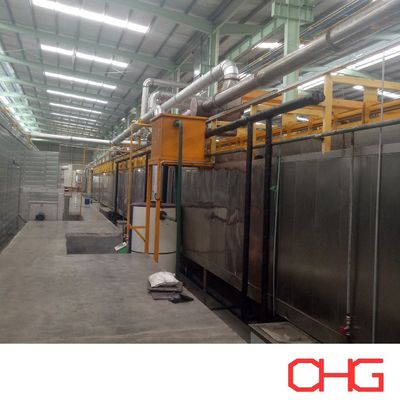
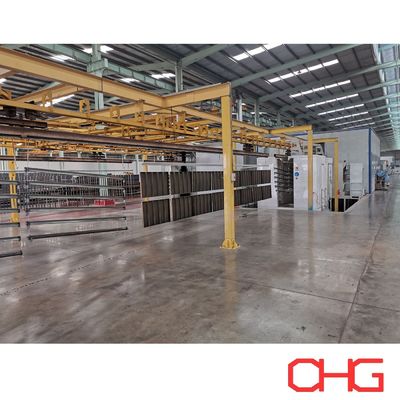
This production line is designed to process aluminum profiles with different cross-sectional shapes, lengths, and coating requirements. An overhead conveyor transports the suspended profiles through the production stages, while manual loading and unloading provide flexibility for handling different product dimensions.
The system can integrate chemical pretreatment, moisture drying, electrostatic powder spraying, thermal curing, cooling, and inspection into a coordinated production process.
Rather than using a fixed equipment configuration, CHG develops each aluminum profile coating line according to the customer's product specifications, production capacity, available factory space, and required coating performance.
| Equipment | Main Function |
|---|---|
| Manual Loading Station | Position aluminum profiles onto conveyor hangers |
| Overhead Conveyor | Transport suspended profiles between processing sections |
| Chemical Pretreatment System | Clean and prepare aluminum surfaces |
| Drying Oven | Remove residual moisture after pretreatment |
| Powder Spray Booth | Provide an enclosed powder application area |
| Electrostatic Spray Equipment | Apply powder coating to aluminum profiles |
| Powder Recovery System | Collect oversprayed powder |
| Curing Oven | Heat and cure the applied powder coating |
| Cooling Section | Reduce product temperature before handling |
| Inspection Station | Check finished coating quality |
| Manual Unloading Station | Remove coated profiles from the conveyor |
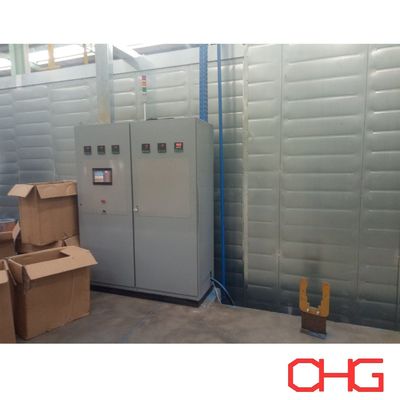
| Electrical Control System | Coordinate production line equipment |
Equipment dimensions and operating parameters are customized according to the workpieces and required production output.
The overhead conveyor is an important part of the aluminum profile powder coating line.
Aluminum extrusions are suspended from suitable hangers and transported through the coating process. This arrangement keeps the workpieces elevated and provides access to the surfaces requiring treatment.
The conveyor system is engineered according to several factors:
Maximum aluminum profile length
Cross-sectional dimensions
Individual profile weight
Number of profiles per hanger
Required hanger spacing
Conveyor speed
Production capacity
Factory clear height
Available workshop layout
The hanging method is selected to maintain stable transportation and suitable coating accessibility.
For long aluminum extrusions, hanger spacing and workpiece movement require particular attention to reduce swinging and interference between adjacent profiles.
Operators place aluminum profiles onto customized hangers at the beginning of the production line.
After coating, curing, and cooling, the finished profiles are manually removed.
This arrangement allows manufacturers to handle different extrusion shapes and product batches without requiring fully automated loading and unloading equipment.
Appropriate surface preparation is essential for achieving the required adhesion and corrosion resistance of powder-coated aluminum products.
Before powder application, aluminum profiles must be cleaned and treated using a process compatible with the substrate and coating specification.
Aluminum extrusions may contain processing oils, lubricants, dust, and other contaminants from previous manufacturing operations.
The cleaning section removes these substances to prepare the metal surfaces for subsequent chemical treatment.
Depending on the product characteristics and production requirements, cleaning can be performed using a suitable spray or immersion process.
After cleaning, aluminum profiles undergo chemical pretreatment to prepare the substrate for powder coating.
Depending on the required coating performance and applicable environmental requirements, the process may use chromate or chrome-free conversion treatment.
The selected system should be compatible with the aluminum alloy, powder coating material, and intended service environment.
Rinsing stages remove residual chemicals between treatment steps.
The number of rinsing stages and required water quality are determined according to the selected pretreatment process.
Suitable rinsing helps maintain stable treatment conditions and reduce surface contamination before coating.
Following chemical pretreatment, the aluminum profiles enter the drying section.
The drying oven removes residual moisture from the workpiece surfaces, including water that may remain inside channels or recessed areas.
Drying conditions are established according to the profile dimensions, material thickness, hanging arrangement, and conveyor speed.
Proper drying is important because residual moisture can contribute to coating defects during powder application and curing.
After drying, the aluminum profiles are transported into the powder spray booth.
Electrostatic spray guns apply charged powder particles onto the grounded aluminum surfaces.
The powder adheres to the workpieces through electrostatic attraction before entering the curing stage.
Depending on the customer's production requirements, the spraying system can incorporate:
Automatic electrostatic powder guns
Vertical reciprocators
Manual spraying stations
Powder feeding equipment
Spray gun control systems
Powder extraction and recovery equipment
The number and arrangement of spray guns are determined according to the profile dimensions, cross-sectional geometry, conveyor speed, and required coating thickness.
Aluminum extrusions are manufactured in a wide variety of shapes, including flat surfaces, channels, hollow sections, and decorative profiles.
These geometries can affect powder deposition, particularly around recessed areas and internal corners.
Spray gun positioning, application angles, grounding, and powder delivery parameters should therefore be evaluated according to the actual profile design.
Where necessary, additional spraying positions or manual touch-up can be incorporated to improve coverage of specified surfaces.
The powder spray booth can be connected to an extraction and recovery system to collect oversprayed powder.
Depending on the production configuration, the recovery equipment may include cyclone separation, cartridge filtration, or other suitable collection arrangements.
The recovery system is selected according to:
Required production capacity
Powder characteristics
Number of coating colors
Color-change frequency
Spray booth dimensions
Coating quality requirements
Recovered powder may be reused when permitted by the powder manufacturer's recommendations and the customer's quality specifications.
After powder application, the profiles enter the curing oven.
During controlled heating, the powder coating melts and flows to form a continuous film. Thermosetting powder coatings subsequently undergo chemical cross-linking to develop their specified properties.
The curing oven is designed according to the powder manufacturer's technical requirements.
Important factors include:
Required metal temperature
Curing residence time
Aluminum profile thickness
Workpiece loading density
Conveyor speed
Oven air circulation
Temperature uniformity
Heating energy
Because aluminum profiles can have different wall thicknesses and cross-sectional designs, curing conditions should be evaluated according to the actual workpieces.
Following curing, the coated aluminum profiles move into the cooling area.
Natural or forced-air cooling can be selected according to the production capacity and available workshop space.
Once the products reach a suitable handling temperature, they proceed to inspection and unloading.
Finished profiles can be evaluated according to the required coating standards.
Typical inspection items include:
Dry film thickness
Surface appearance
Color consistency
Gloss level
Coating adhesion
Visible surface defects
Coating coverage
Additional performance testing may be required depending on whether the products are intended for architectural, decorative, or industrial applications.
This production line can be customized for different aluminum extrusion products, including:
Architectural aluminum profiles
Aluminum window frames
Door frame profiles
Curtain wall components
Aluminum partition systems
Decorative aluminum extrusions
Industrial aluminum profiles
Aluminum furniture components
Aluminum support structures
Fabricated aluminum products
Different applications may require specific pretreatment methods, powder formulations, coating thicknesses, and performance standards.
The overhead conveyor and customized hangers can be designed to accommodate aluminum extrusions with different lengths and cross-sectional shapes.
Surface pretreatment, drying, spraying, curing, and cooling can be integrated into one production line, reducing unnecessary workpiece transfers.
Manual loading and unloading allow operators to handle different profile types and production batches.
The conveyor, spraying equipment, and curing system can be configured to support repeatable processing conditions.
Pretreatment equipment can be selected according to the aluminum alloy, coating material, and required corrosion resistance.
The production line arrangement is developed according to the available workshop dimensions, production targets, and material flow.
| Parameter | Available Configuration |
|---|---|
| Product | Aluminum profiles and extrusions |
| Maximum Profile Length | Customized |
| Maximum Profile Weight | According to conveyor and hanger design |
| Conveyor Type | Overhead conveyor |
| Loading Method | Manual |
| Unloading Method | Manual |
| Pretreatment | Compatible aluminum chemical conversion treatment |
| Powder Application | Electrostatic spraying |
| Spray Booth | Customized |
| Powder Recovery | According to production requirements |
| Drying System | Integrated moisture drying |
| Curing Oven | Designed according to powder specifications |
| Cooling | Natural or forced-air |
| Conveyor Speed | Calculated according to production capacity |
| Automation Level | Project-specific |
| Workshop Layout | Customized |
CHG develops aluminum profile powder coating production lines according to the customer's actual manufacturing conditions.
To prepare a preliminary technical proposal, please provide:
Aluminum profile drawings or photographs
Maximum profile length, width, and height
Maximum weight per profile
Required hourly or daily production capacity
Number of profiles per hanger
Required coating thickness
Powder coating type
Number of colors
Color-change frequency
Pretreatment requirements
Applicable coating standards
Available workshop dimensions
Factory clear height
Heating energy and electrical supply
Required automation level
Based on these parameters, CHG can evaluate the conveyor layout, pretreatment system, spray booth, powder recovery equipment, curing oven, and overall production line configuration.
CHG supplies customized powder coating production lines for aluminum extrusion manufacturers and industrial metal finishing facilities.
The system integrates an overhead conveyor, manual loading and unloading, aluminum surface pretreatment, electrostatic powder spraying, curing, and cooling into a complete coating process.
Each production line is engineered according to the customer's aluminum profile dimensions, coating requirements, production capacity, and factory layout.
Contact CHG with your aluminum profile specifications and production requirements to receive a customized powder coating line proposal and quotation.