|
|
| Brand Name: | CHG |
| Model Number: | AC-26 |
| MOQ: | 1 set |
| Price: | 100,000-200,000 USD |
| Payment Terms: | L/C,D/A,T/T,D/P |
| Supply Ability: | 20 sets per year |
Custom Manual Powder Coating Production Line for Industrial Metal Parts
CHG designs and supplies manual powder coating production lines with overhead conveyor systems for manufacturers processing metal components of different sizes, shapes, and production volumes.
This equipment configuration combines manual electrostatic powder spraying, a carbon steel spray booth, conveyorized workpiece transportation, thermal curing, and natural cooling.
The production line is designed for manual spraying during its initial operation, while the spray booth includes reserved installation positions for future automatic spraying equipment.
This approach allows manufacturers to establish an integrated powder coating process while retaining flexibility for potential automation upgrades as production requirements develop.
| Equipment | Description |
|---|---|
| Powder Spray Booth | Heavy-duty carbon steel construction |
| Spraying Method | Manual electrostatic powder application |
| Conveyor System | Overhead conveyor |
| Loading | Manual |
| Unloading | Manual |
| Curing System | Integrated powder curing oven |
| Cooling | Natural cooling |
| Future Expansion | Reserved positions for automatic spray guns |
| Production Capacity | Customized according to workpiece requirements |
| Factory Layout | Project-specific engineering |
The final equipment dimensions, conveyor arrangement, and operating parameters are determined according to the customer's products and production conditions.
Manual powder application is suitable for manufacturers handling different workpiece geometries or frequently changing production batches.
Operators use electrostatic spray guns to apply powder onto grounded metal components.
During spraying, the operator can adjust the gun position, spraying angle, distance, and application technique according to the product shape.
This provides flexibility when coating:
Irregular metal structures
Welded components
Products with corners and edges
Recessed surfaces
Different workpiece dimensions
Small and medium production batches
Products requiring additional attention to specific surfaces
Manual spraying is particularly useful when the product range changes frequently or when automatic gun positioning would require repeated adjustments.
Coating performance depends on the powder material, equipment settings, workpiece grounding, surface preparation, and operator technique.
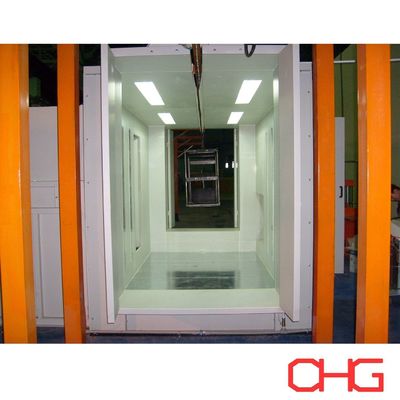
The production line incorporates a carbon steel powder coating booth designed to provide a dedicated working area for manual electrostatic spraying.
The booth structure is developed according to the maximum workpiece dimensions, conveyor arrangement, and required operator access.
The booth can be configured with:
Manual spraying positions
Suitable lighting
Conveyor passage openings
Powder extraction equipment
Filtration and powder collection systems
Maintenance access
Reserved automatic spray gun installation positions
Booth dimensions and internal arrangements are selected according to the number of operators, product geometry, and required production capacity.
The powder extraction system is designed to collect airborne overspray and maintain suitable operating conditions inside the spraying area.
An important feature of this production line is the consideration of future automation during the initial equipment design.
Although powder application is performed manually, the spray booth includes reserved positions intended for automatic spray gun installation.
If production volumes increase or product designs become more standardized, the customer may consider upgrading the spraying section.
Potential additional equipment includes:
Automatic electrostatic spray guns
Vertical reciprocators
Automatic gun mounting structures
Powder feeding equipment
Spray gun control systems
Integration with conveyor controls
Planning for future automation can reduce the extent of structural modifications required during an upgrade.
However, the feasibility of installing automatic spraying equipment depends on the original booth dimensions, extraction capacity, electrical configuration, conveyor arrangement, and selected automation equipment.
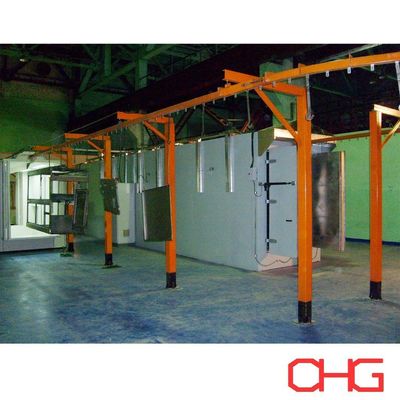
The overhead conveyor connects the spraying, curing, cooling, and loading/unloading areas.
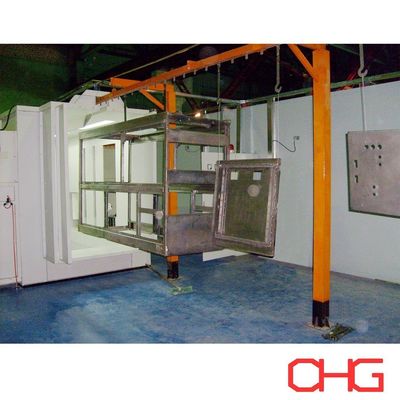
Workpieces are suspended from suitable hangers and transported through the main coating stages.
This arrangement reduces repeated manual transfers between separate pieces of equipment and helps organize the production flow.
The conveyor is engineered according to:
Maximum workpiece dimensions
Individual workpiece weight
Number of components per hanger
Hanger spacing
Required conveyor speed
Production capacity
Factory clear height
Curing residence time
Loading and unloading requirements
Customized hangers can be designed to support different metal components and provide access to the surfaces requiring coating.
The conveyor route is coordinated with the spray booth, curing oven, cooling area, and available workshop dimensions.
The production sequence is straightforward:
Manual Loading → Manual Electrostatic Spraying → Thermal Curing → Natural Cooling → Manual Unloading
Surface cleaning and pretreatment requirements are evaluated according to the workpiece material and coating specification. Where necessary, suitable pretreatment equipment can be integrated into the complete production line.
Operators place metal components onto conveyor hangers at the loading station.
The hanging arrangement is selected according to workpiece geometry, weight, and coating accessibility.
Suitable spacing between components is important for spraying operations and conveyor movement.
The suspended workpieces enter the carbon steel spray booth.
Operators apply electrostatically charged powder using manual spray guns.
Spraying techniques can be adjusted according to the workpiece shape, particularly around corners, welded joints, and recessed sections.
The required coating thickness is determined by the powder specification and finished product requirements.
After spraying, the conveyor transfers the coated workpieces into the curing oven.
Controlled heating causes the powder coating to melt and flow. Thermosetting powder coatings then undergo chemical cross-linking to develop their specified properties.
The curing system is designed according to the powder manufacturer's requirements, taking into account workpiece dimensions, metal thickness, required metal temperature, and production capacity.
Following curing, the coated components move into the natural cooling area.
The workpieces remain in this section until their temperature decreases sufficiently for safe handling and unloading.
The cooling arrangement is developed according to the product mass, conveyor speed, and available factory space.
After cooling, operators remove the finished products from the conveyor.
The coated components can then proceed to quality inspection, assembly, packaging, or other manufacturing operations.
Typical inspection items include coating thickness, appearance, adhesion, and visible surface defects.
Manual and automatic powder spraying systems serve different manufacturing requirements.
| Feature | Manual Powder Spraying | Automatic Powder Spraying |
|---|---|---|
| Application Method | Operator-controlled spray guns | Programmed or mechanically controlled spray guns |
| Product Flexibility | Suitable for frequent product changes | Effective for repeatable product geometries |
| Complex Surfaces | Operators can adjust spraying positions directly | May require additional guns or manual touch-up |
| Production Capacity | Depends on operator availability and workpiece complexity | Can support higher throughput for suitable products |
| Initial Equipment Investment | Generally lower | Generally higher |
| Labor Requirements | Requires spraying operators | Reduces direct spraying labor but requires system supervision |
| Process Repeatability | Influenced by operator technique | More consistent for established spraying programs |
| Equipment Adjustment | Direct manual adjustment | Mechanical or programmed adjustment |
| Typical Applications | Mixed-product and variable-batch production | Repetitive production with consistent workpiece designs |
Powder transfer efficiency cannot be determined solely by whether the application is manual or automatic. It also depends on the spray equipment, powder characteristics, workpiece geometry, grounding, airflow, and operating parameters.
Manual spraying allows operators to adapt the coating process to products with different dimensions and geometries.
This is useful for manufacturers handling multiple product types or changing production schedules.
The overhead conveyor transports components between spraying, curing, and cooling, reducing the need for repeated manual movement.
The production line provides an integrated coating process without requiring automatic spray guns during initial operation.
Reserved installation positions allow future spraying automation to be considered during the original design.
The carbon steel spray booth provides a rigid industrial enclosure that can be customized for different workpiece dimensions and operator arrangements.
The conveyor track, spray booth, curing oven, and cooling area are arranged according to the available workshop space and required material flow.
This manual powder coating line can be adapted for different manufactured metal products, including:
Metal furniture frames
Electrical cabinets and enclosures
Machinery components
Fabricated steel structures
Storage racks and shelving
Industrial equipment frames
Metal brackets and supports
Agricultural machinery parts
Metal doors and accessories
General fabricated metal components
The equipment configuration is selected according to workpiece dimensions, coating requirements, production capacity, and handling conditions.
CHG develops each powder coating production line according to the customer's actual manufacturing requirements.
| Parameter | Customization Scope |
|---|---|
| Workpiece Material | Steel, aluminum, and other suitable conductive metals |
| Maximum Dimensions | According to product specifications |
| Maximum Weight | According to conveyor and hanger design |
| Spray Booth | Carbon steel, customized dimensions |
| Powder Application | Manual electrostatic spray guns |
| Automatic Spraying Provision | Reserved installation positions |
| Conveyor | Overhead conveyor system |
| Conveyor Speed | Calculated according to production requirements |
| Loading and Unloading | Manual |
| Pretreatment | According to substrate and coating requirements |
| Curing Oven | Designed according to powder and workpiece characteristics |
| Cooling | Natural cooling |
| Powder Extraction | Configured according to spraying requirements |
| Control System | Project-specific |
| Workshop Layout | Customized |
To develop a suitable production line layout and quotation, please provide:
Workpiece drawings or photographs
Product material
Maximum length, width, and height
Maximum workpiece weight
Required hourly or daily production capacity
Number of products per hanger
Required powder coating thickness
Powder type and coating specifications
Number of colors
Color-change frequency
Surface pretreatment requirements
Available workshop dimensions
Factory clear height
Available heating energy
Local electrical supply
Future automation plans
Based on this information, CHG can develop an integrated equipment proposal covering the overhead conveyor, carbon steel powder spray booth, manual spraying equipment, powder extraction system, curing oven, cooling section, and provisions for future automatic spraying.
CHG provides complete powder coating production line solutions for industrial manufacturers seeking flexible coating equipment with integrated material handling.
This configuration combines manual electrostatic spraying, a carbon steel powder spray booth, overhead conveyor transportation, thermal curing, and reserved automatic spraying positions.
The production line is engineered to meet current manufacturing requirements while considering potential future expansion.
Contact CHG with your workpiece specifications, production capacity, and workshop conditions to receive a customized manual powder coating line proposal and quotation.