|
|
| Brand Name: | CHG |
| Model Number: | AC-01 |
| MOQ: | 1 set |
| Price: | 1,000,000 - 2,000,000 USD |
| Payment Terms: | L/C,D/A,D/P,T/T |
| Supply Ability: | 10 sets per year |
CHG designs and supplies electrophoretic coating production lines (KTL / CED / E-coating) for automotive components and other conductive metal products requiring reliable corrosion protection.
The system uses an electrically controlled immersion process to deposit a protective coating onto prepared metal surfaces. Compared with conventional spray application, electrophoretic deposition can provide effective coverage of many recessed areas and complex geometries, making it suitable for industrial components with demanding surface protection requirements.
Our engineering solutions integrate chemical pretreatment, electrophoretic deposition, paint circulation, ultrafiltration, rinsing, curing, material handling, and process controls.
Each production line is developed according to the customer's workpiece dimensions, required coating performance, production capacity, and factory conditions.
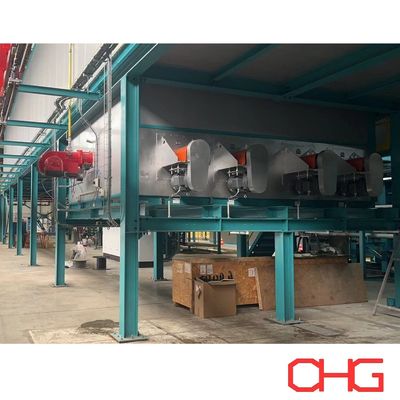
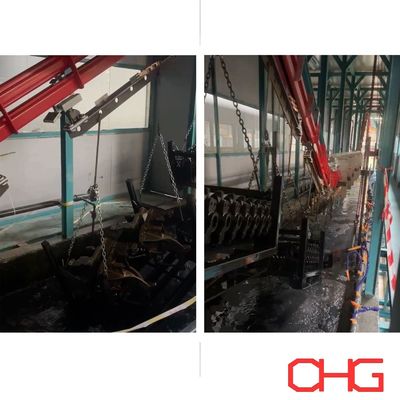
One of CHG's project applications involves an electrophoretic coating system developed for automotive battery enclosure manufacturing.
Battery enclosures often feature welded structures, internal corners, reinforcing sections, and other complex geometries. These characteristics require careful consideration during coating equipment design.
For this application, the production line was engineered around the customer's product specifications, factory layout, and required manufacturing output.
The project involved customized engineering, equipment manufacturing, overseas installation support, commissioning, and operator training.
Engineering and Layout DevelopmentDuring the initial design stage, the project team evaluated the customer's technical requirements and available workshop conditions.
The engineering process included:
Review of battery enclosure dimensions and production requirements
Assessment of coating process specifications
Equipment sizing and arrangement
Development of CAD layouts
Coordination of material handling and processing stages
Review of maintenance access and operating space
Technical drawing revisions and final design confirmation
The equipment layout was refined according to the customer's manufacturing requirements before production began.
Equipment Manufacturing and Quality InspectionFollowing approval of the technical design, equipment manufacturing proceeded according to the agreed drawings and specifications.
Quality control activities were incorporated during fabrication and assembly to verify relevant equipment dimensions, construction quality, and conformity with the approved design.
Manufacturing progress was communicated to the customer throughout the project to support coordination and preparation for installation.
Overseas Installation and CommissioningAfter equipment delivery, CHG provided technical support for installation and commissioning at the customer's facility.
The implementation covered equipment assembly, system adjustments, process testing, and preparation for production operation.
For this referenced project, the installation and commissioning phase was completed within approximately six months.
The actual implementation period for other projects depends on equipment scope, site readiness, installation conditions, and commissioning requirements.
Operator and Maintenance TrainingTechnical training was provided to help the customer's personnel operate and maintain the production line.
The training included:
Equipment startup and shutdown procedures
Production line operation
Process parameter adjustment
Routine inspection and maintenance
Fault identification
Troubleshooting procedures
Safe equipment operation
The objective was to support a smooth transition from commissioning to regular production.
A complete electrophoretic coating line can be arranged as follows:
Loading → Degreasing → Water Rinsing → Chemical Pretreatment → Final Rinsing → KTL Deposition → Ultrafiltration Rinsing → Final Rinsing → Thermal Curing → Cooling → Inspection → Unloading
The exact number of treatment stages and process conditions are selected according to the substrate, coating material, and required performance.
1. Surface CleaningBefore electrophoretic deposition, metal components are cleaned to remove oils, grease, dust, and fabrication residues.
Cleaning prepares the substrate for subsequent chemical treatment and helps reduce coating defects.
The cleaning process is selected according to the workpiece material and surface condition.
2. Chemical PretreatmentAfter cleaning, the workpieces receive suitable chemical surface treatment.
Depending on the substrate and coating specification, the process may include rinsing, surface conditioning, and conversion coating.
Steel components may use phosphate or alternative conversion treatment systems. Aluminum and galvanized substrates require compatible chemical processes.
The pretreatment method is determined according to the coating performance requirements and the materials being processed.
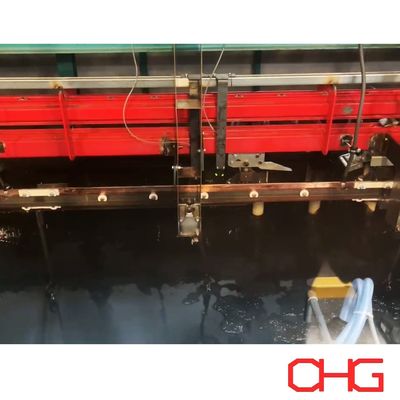
3. Electrophoretic DepositionPrepared workpieces enter the E-coating tank.
During cathodic electrodeposition, the workpiece acts as the cathode, and the applied electrical field causes coating material to deposit onto its conductive surfaces.
Important process parameters include:
Applied voltage and current
Deposition time
Bath temperature
Paint solids content
Bath pH
Conductivity
Workpiece geometry
Coating formulation
These parameters are controlled according to the selected paint system and required film thickness.
4. Ultrafiltration and RinsingFollowing deposition, the coated components pass through rinsing stages to remove excess coating material.
An ultrafiltration system can recover paint components and provide permeate for rinsing.
This arrangement helps manage paint consumption and maintain suitable coating bath conditions.
5. Thermal CuringAfter rinsing, the coated workpieces enter the curing oven.
Controlled heating develops the final coating properties through the curing reactions specified by the paint manufacturer.
Oven design considers workpiece mass, metal thickness, required metal temperature, production capacity, and conveyor arrangement.
6. Cooling and InspectionFollowing curing, the components are cooled before handling.
Finished products are inspected according to the customer's quality standards.
Typical inspection items include dry film thickness, coating appearance, adhesion, curing performance, and corrosion resistance.
| Equipment | Main Function |
|---|---|
| Loading and Unloading Stations | Workpiece handling |
| Pretreatment System | Surface cleaning and chemical treatment |
| Rinsing Tanks | Removal of process residues |
| KTL Coating Tank | Electrophoretic deposition |
| DC Rectifier | Supply and control of deposition voltage |
| Anode System | Support the electrodeposition process |
| Paint Circulation System | Maintain bath circulation |
| Filtration Equipment | Remove unwanted particles |
| Ultrafiltration System | Paint recovery and rinsing support |
| Heat Exchange System | Coating bath temperature control |
| Conveyor System | Workpiece transfer between process stages |
| Curing Oven | Thermal curing of deposited coating |
| Cooling Section | Workpiece cooling |
| PLC / HMI System | Equipment monitoring and process coordination |
The final equipment configuration is determined according to the required coating process and factory layout.
Electrophoretic deposition can provide coating coverage on many recessed surfaces and difficult-to-access areas.
The actual coverage depends on the workpiece geometry, bath characteristics, electrical conditions, and process design.
Corrosion ProtectionWhen combined with suitable pretreatment and curing, KTL coating provides a protective film that can help improve the corrosion resistance of metal components.
Performance depends on the coating formulation, substrate, film thickness, and operating environment.
Repeatable Industrial ProcessingThe coating process can be integrated with automated workpiece transportation and controlled deposition parameters.
This supports repeatable operation in industrial manufacturing environments.
Efficient Paint UtilizationUnlike spray coating, electrophoretic deposition does not generate conventional spray overspray.
Ultrafiltration and rinsing equipment can recover coating material, helping reduce paint losses.
Water-Based Coating ProcessMost industrial E-coating systems use water-based paint formulations.
These generally have lower solvent emissions than many conventional solvent-based coating processes, although appropriate ventilation, wastewater treatment, and chemical handling remain necessary.
Integrated Process MonitoringControl systems can monitor operating conditions such as bath temperature, voltage, current, and other relevant process parameters.
These functions help operators maintain stable coating conditions and identify deviations requiring adjustment.
KTL coating is commonly used for conductive metal components, including suitable carbon steel, galvanized steel, and aluminum parts.
Substrate compatibility must be confirmed with the selected coating chemistry and pretreatment process.
Typical applications include:
Automotive battery enclosures
Vehicle structural components
Metal brackets and supports
Automotive chassis parts
Industrial machinery components
Electrical enclosures
Fabricated steel assemblies
Other conductive metal products requiring corrosion protection
Different applications may require different coating formulations, pretreatment systems, and quality testing procedures.
A stable E-coating process requires appropriate monitoring of bath chemistry, deposition conditions, and curing performance.
Depending on the selected coating system, the production line can incorporate monitoring of:
Bath temperature
pH
Conductivity
Paint solids content
Applied voltage and current
Deposition time
Circulation and filtration conditions
Ultrafiltration operation
Curing oven temperature
Finished coating properties are verified through appropriate inspection and testing procedures.
These may include film thickness measurement, adhesion testing, appearance assessment, and corrosion resistance testing according to the applicable specifications.
CHG develops electrophoretic coating equipment according to the customer's actual manufacturing requirements.
| Design Parameter | Engineering Considerations |
|---|---|
| Workpiece Material | Steel, aluminum, galvanized steel, or compatible metal substrate |
| Workpiece Dimensions | Maximum length, width, and height |
| Workpiece Weight | Individual component weight and handling requirements |
| Production Capacity | Required output per hour, shift, or year |
| Coating Material | Selected KTL / CED paint formulation |
| Coating Thickness | Required dry film thickness |
| Pretreatment | Chemical process according to substrate |
| Conveyor System | Selected according to product and production requirements |
| Tank Dimensions | Determined by workpiece envelope and immersion requirements |
| Curing System | Designed according to coating and workpiece characteristics |
| Control System | Project-specific automation and monitoring |
| Workshop Layout | Customized according to available factory space |
To prepare a preliminary design and quotation, please provide:
Workpiece drawings or photographs
Substrate material
Maximum dimensions and weight
Required production capacity
Coating type and film thickness
Corrosion resistance requirements
Pretreatment specifications
Selected paint supplier or coating technical data
Available workshop dimensions
Factory clear height
Heating energy and electrical supply
Water and compressed air availability
Required automation level
Applicable quality standards
Based on this information, CHG can develop a technical proposal covering the pretreatment system, KTL coating tank, paint circulation and filtration, ultrafiltration equipment, conveyor arrangement, curing system, electrical controls, and overall production line layout.
CHG provides customized electrophoretic coating production lines for automotive and industrial manufacturers requiring integrated corrosion protection systems.
Our project scope can cover engineering design, equipment manufacturing, overseas installation coordination, commissioning support, and technical training.
With experience in automotive battery enclosure E-coating applications, CHG can develop production line solutions based on specific workpiece characteristics, coating standards, and factory requirements.
Contact CHG with your product specifications and production requirements to receive a customized KTL electrophoretic coating line proposal and quotation.