|
|
| Brand Name: | CHG |
| Model Number: | AC-26 |
| MOQ: | 1 set |
| Price: | 100,000-200,000 USD |
| Payment Terms: | T/T,D/P,D/A,L/C |
| Supply Ability: | 10 sets per year |
Industrial Manual Powder Coating Line with Carbon Steel Spray Booth
Conveyorized Powder Coating System Designed for Future Automation
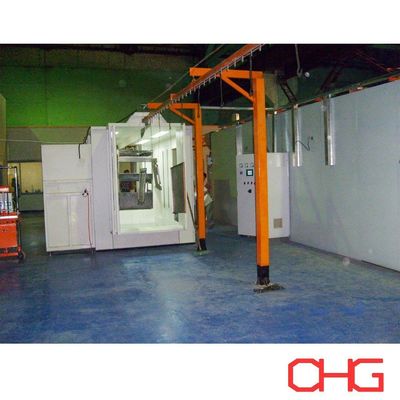
CHG provides customized manual powder coating production lines for manufacturers requiring flexible coating operations, organized material handling, and the possibility of upgrading to automatic spraying in the future.This system combines manual electrostatic powder application with an overhead conveyor, a carbon steel spray booth, a curing oven, and a natural cooling area. Workpieces are manually loaded onto the conveyor and transported through the main coating stages before being unloaded after cooling.An important feature of this configuration is the reserved installation space for automatic spraying equipment. The production line can initially operate with manual spray guns while allowing future automation requirements to be considered during the original equipment design.This approach is suitable for industrial manufacturers handling different metal products, particularly where production volumes or product varieties do not yet justify a fully automatic spraying system.
Production Line Overview
The equipment arrangement consists of several coordinated sections:
|
Equipment |
Main Function |
|---|---|
|
Manual Loading Station |
Positioning metal components onto conveyor hangers |
|
Overhead Conveyor |
Transporting workpieces between coating stages |
|
Carbon Steel Spray Booth |
Providing an enclosed area for manual powder application |
|
Electrostatic Spray Guns |
Applying powder coating to metal surfaces |
|
Powder Extraction System |
Collecting airborne overspray |
|
Curing Oven |
Heating coated components according to powder curing requirements |
|
Natural Cooling Area |
Allowing coated workpieces to cool before handling |
|
Manual Unloading Station |
Removing finished components from the conveyor |
|
Reserved Spraying Positions |
Allowing consideration of future automatic spray equipment |
The complete configuration is determined according to workpiece dimensions, coating specifications, production capacity, and available workshop space.
Manual Powder Application for Different Metal Products
Manual electrostatic spraying provides operators with direct control over the powder application process.Unlike a fixed automatic spraying arrangement, operators can adjust their working position, spray gun angle, and application distance according to the shape of each component.This is especially useful when processing products with:
Irregular geometries
Welded structures
Corners and edges
Recessed surfaces
Different lengths and widths
Frequently changing product designs
Small or medium production batches
The electrostatic spray guns charge powder particles, which are attracted to grounded metal workpieces.Suitable spraying techniques, equipment settings, and operator practices help achieve the required coating coverage and film thickness.For manufacturers producing several product types, manual application provides flexibility without requiring automatic spray gun programming for every product variation.
Carbon Steel Powder Spray Booth
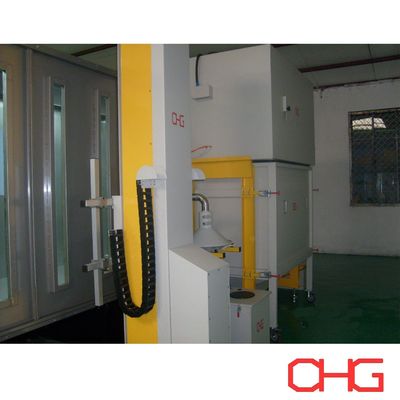
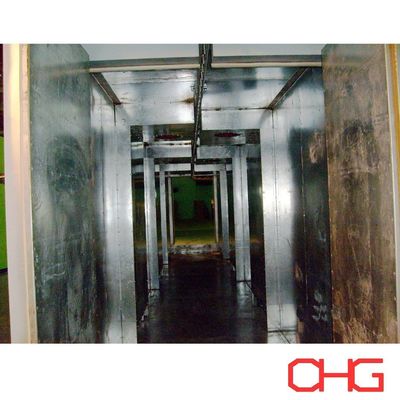
The coating line uses a carbon steel powder spray booth designed for industrial powder application.The booth provides a dedicated spraying enclosure and can be equipped with suitable extraction and filtration equipment to collect airborne powder.Its structural dimensions and internal arrangement are selected according to the products being coated and the required working space for operators.
Spray Booth Design Considerations
Important factors include:
Maximum workpiece size
Workpiece hanging orientation
Conveyor opening dimensions
Number of manual spraying operators
Spray gun positions
Powder extraction requirements
Booth accessibility
Cleaning and maintenance requirements
Space reserved for future automation
The powder extraction and recovery arrangement can be selected according to the production volume, powder characteristics, and color-change requirements.For projects involving several coating colors, the booth layout should also consider the time and procedures required for cleaning between production batches.
Prepared for Future Automatic Spraying
One of the main design considerations of this production line is its potential for future expansion.The initial equipment configuration uses manual electrostatic powder spray guns. However, the spray booth includes reserved positions intended for the possible installation of automatic spraying equipment.Depending on the final engineering assessment, future upgrades may include:
Automatic electrostatic powder spray guns
Vertical reciprocators
Automatic gun mounting structures
Additional powder feeding equipment
Automatic spraying controls
Integration with the production line control system
Benefits of Planning for Expansion
Considering future automation during the original design can help reduce the structural modifications required when production demands increase.For example, the initial booth arrangement can take account of the space needed for reciprocators, gun positioning, maintenance access, and electrical connections.Actual upgrade feasibility and capacity will depend on the original booth dimensions, conveyor arrangement, ventilation capacity, electrical system, and selected automatic spraying equipment.This configuration provides a practical development path for manufacturers planning to increase production automation over time.
Overhead Conveyor for Integrated Material Handling
The overhead conveyor connects the spraying, curing, cooling, and handling areas.After workpieces are manually suspended from suitable hangers, the conveyor transports them through the coating process.This arrangement reduces the need to repeatedly move components between separate pieces of equipment.
Conveyor Engineering
The conveyor is designed according to:
Maximum workpiece dimensions
Maximum hanging weight
Number of workpieces per hanger
Required production output
Hanger center distance
Conveyor operating speed
Workshop clear height
Loading and unloading positions
Required curing residence time
Customized hangers can be developed to maintain suitable workpiece positioning during powder spraying and curing.The conveyor route is coordinated with the available factory space and equipment layout.
Powder Coating Process Sequence
The production line follows a straightforward coating sequence:Manual Loading → Electrostatic Powder Spraying → Thermal Curing → Natural Cooling → Manual UnloadingSurface pretreatment requirements are evaluated separately according to the substrate condition and coating specification. Where required, suitable cleaning or pretreatment equipment can be incorporated into the overall production solution.
Stage 1: Workpiece Loading
Metal components are positioned onto conveyor hangers at the loading station.The hanging arrangement must provide adequate support while allowing operators to access the surfaces requiring coating.Workpiece spacing and orientation are selected according to product geometry, spraying accessibility, and conveyor capacity.
Stage 2: Manual Electrostatic Spraying
The conveyor transports the workpieces into the carbon steel powder spray booth.Operators apply powder using manual electrostatic guns, adjusting their spraying technique to accommodate the geometry of each component.Particular attention can be given to corners, edges, welded areas, and recessed surfaces.The required coating thickness and application conditions depend on the powder specification and finished product requirements.
Stage 3: Powder Curing
Following powder application, the workpieces enter the curing oven.During the curing process, the applied powder melts, flows, and chemically cross-links to form a continuous coating film.The curing system is designed according to the powder manufacturer's specifications and the thermal characteristics of the workpieces.Important factors include the required metal temperature, workpiece thickness, product dimensions, conveyor speed, and heating method.Correct curing conditions are essential for achieving the specified coating appearance, adhesion, and mechanical properties.
Stage 4: Natural Cooling
After curing, the workpieces leave the oven and enter the natural cooling section.The conveyor continues transporting the coated components while their temperature gradually decreases.The cooling area and available residence time are considered during production line design to ensure that products reach a suitable handling temperature before unloading.
Stage 5: Unloading and Inspection
Finished components are removed manually after sufficient cooling.The coated products can then proceed to inspection, assembly, packaging, or other manufacturing operations.Depending on the customer's quality requirements, inspection may include coating thickness, surface appearance, adhesion, color, gloss, and visible defects.
Advantages of the Manual Conveyorized Powder Coating Line
Flexibility for Multiple Workpiece Designs
Manual spraying allows operators to adapt their application techniques to products with different geometries and dimensions.This is useful for manufacturers producing several product categories or frequently changing production batches.
Automatic Transportation Between Processes
Although spraying and loading remain manual, the overhead conveyor provides organized workpiece movement through the production line.This reduces repeated manual transfers and helps coordinate the main coating stages.
Practical Initial Equipment Configuration
The line combines manual powder application with conveyorized handling and curing.It is suitable for manufacturers that require an integrated production system but do not currently need fully automatic spraying equipment.
Provision for Automation Upgrades
Reserved installation positions allow future automatic spraying requirements to be considered without necessarily replacing the entire booth structure.
Customized Workshop Arrangement
The equipment layout can be adapted to available factory dimensions, workpiece flow, loading requirements, and maintenance access.
Typical Industrial Applications
This type of manual powder coating line can be configured for various metal components, including:
Metal furniture frames
Machinery components
Fabricated steel parts
Electrical enclosures
Metal brackets and supports
Storage equipment
Industrial frames
Agricultural equipment components
Metal doors and accessories
General manufactured metal products
The appropriate equipment configuration depends on workpiece material, geometry, weight, coating specification, and required production capacity.
Technical Specifications
|
Item |
Configuration |
|---|---|
|
Production Line Type |
Manual electrostatic powder coating line |
|
Spray Booth Construction |
Carbon steel |
|
Powder Application |
Manual electrostatic spray guns |
|
Conveyor |
Overhead conveyor system |
|
Loading |
Manual |
|
Unloading |
Manual |
|
Curing |
Integrated powder curing oven |
|
Cooling |
Natural cooling |
|
Future Automation |
Reserved positions for automatic spraying equipment |
|
Spray Booth Dimensions |
Customized |
|
Conveyor Capacity |
Determined by workpiece requirements |
|
Hanger Design |
Project-specific |
|
Production Capacity |
Customized |
|
Heating Energy |
Selected according to project conditions |
|
Control System |
Configured according to equipment requirements |
|
Workshop Layout |
Custom-engineered |
Customized Powder Coating Equipment from CHG
CHG designs powder coating production lines according to the customer's actual manufacturing conditions.For preliminary technical evaluation, the following information is helpful:
Workpiece drawings or photographs
Material type
Maximum dimensions
Maximum workpiece weight
Required hourly or daily production capacity
Number of products per hanger
Required coating thickness and performance
Pretreatment requirements
Powder specifications
Number of coating colors
Available workshop dimensions
Factory clear height
Available heating energy
Local electrical specifications
Current and future automation requirements
Using these parameters, our engineering team can develop an equipment arrangement covering the overhead conveyor, carbon steel powder spray booth, manual electrostatic spraying equipment, powder extraction and recovery system, curing oven, natural cooling section, customized hangers, and reserved automatic spraying positions.
Manual Powder Coating Solutions with Upgrade Potential
For manufacturers seeking a flexible powder coating process without investing immediately in a fully automatic spraying system, a conveyorized manual line provides a practical alternative.By combining manual electrostatic application, automated workpiece transportation, integrated curing, and space reserved for future spraying equipment, the system can be configured to support current production requirements while considering possible expansion.Contact CHG with your product specifications, required production capacity, and factory layout to receive a customized manual powder coating production line proposal and quotation.