| Brand Name: | CHG |
| Model Number: | AC-16 |
| MOQ: | 1 set |
| Price: | 100,000-200,000 USD |
| Payment Terms: | L/C,D/A,D/P,T/T |
| Supply Ability: | 10 sets per year |
Manual Powder Coating Production Line for Hospital Beds
Customized Powder Coating System for Medical Bed Frames and Components
This manual powder coating production line is designed for hospital beds, medical bed frames, and related fabricated metal components.
Hospital bed structures commonly include steel tubes, welded joints, corners, brackets, and recessed areas. These geometries can require flexible spray angles and careful powder application. A manual electrostatic spraying system allows operators to adjust the spraying position according to the actual workpiece, making it a practical solution for manufacturers handling different bed models or small-to-medium production batches.
The complete production line can be customized to integrate surface pretreatment, moisture drying, manual powder spraying, curing, cooling, and material handling according to the customer's products and required production capacity.
Typical Production Process
A complete hospital bed powder coating process can be configured as:
Loading → Surface Pretreatment → Moisture Drying → Manual Powder Spraying → Powder Curing → Cooling → Inspection → Unloading
The detailed process and equipment configuration are determined according to the substrate material, workpiece dimensions, production volume, and required coating performance.
Surface Pretreatment
Proper pretreatment provides the foundation for reliable powder coating performance.
Before spraying, hospital bed frames and components need to be cleaned to remove contaminants such as:
Oil and grease
Dust and dirt
Welding residues
Processing contamination
Other surface impurities
Depending on the workpiece material and coating requirements, the pretreatment process may incorporate:
Degreasing
Water rinsing
Surface conditioning
Phosphating or other conversion treatment
Final rinsing
The pretreatment system can be designed as either a spray or immersion configuration according to the product geometry and production requirements.
Moisture Drying
After wet pretreatment, residual moisture is removed before powder application.
The drying section prepares the treated workpieces for electrostatic spraying and helps prevent coating defects associated with remaining surface moisture.
Drying conditions are selected according to workpiece dimensions, material thickness, conveyor arrangement, and production capacity.
Manual Electrostatic Powder Spraying
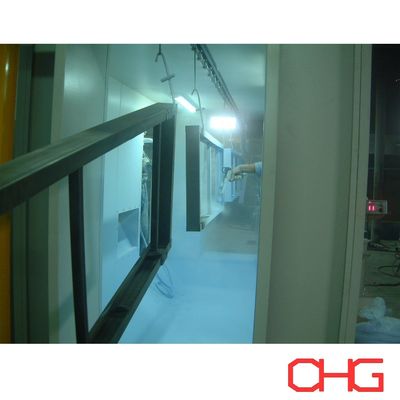
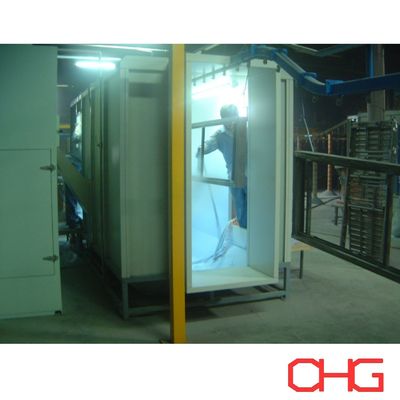
The powder application section uses manual electrostatic spray guns, allowing operators to control spraying according to the geometry of each hospital bed component.
Compared with a fixed automatic spraying pattern, manual operation provides greater flexibility when coating:
Tubular structures
Welded joints
Corners and edges
Brackets
Recessed sections
Components with different dimensions
Frequently changing product models
Operators can adjust the spraying angle, distance, and application pattern to improve powder coverage on complex surfaces.
Powder Spray Booth and Recovery
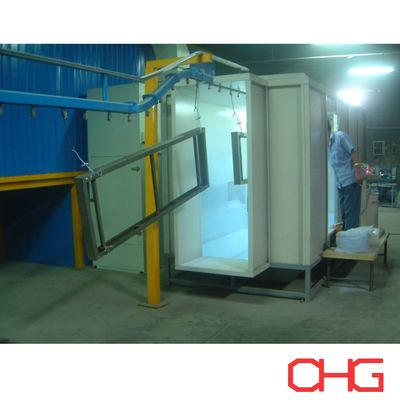
Manual spraying is carried out inside a dedicated powder spray booth equipped with an appropriate extraction and recovery system.
Depending on production requirements, the system can include:
Manual electrostatic spray guns
Powder supply equipment
Spray booth
Extraction system
Powder filtration or recovery equipment
Powder collection equipment
The booth dimensions and operator positions are designed according to the maximum hospital bed dimensions and required spraying access.
Material Handling System
Different conveyor arrangements can be selected according to production capacity and factory conditions.
Possible configurations include:
Continuous overhead conveyor
Power and Free conveyor
Customized suspended handling system
Manual transfer for smaller production volumes
For conveyorized lines, suitable hangers are designed according to the hospital bed frame structure, weight, coating orientation, and required production capacity.
Manual loading and unloading can be retained to provide flexibility for different bed models and component sizes.
Powder Curing
After spraying, coated components are transferred into the curing oven.
Controlled heating causes the powder coating to melt, flow, and chemically cross-link, forming a continuous coating film.
The curing process is designed according to:
Powder manufacturer's specification
Workpiece material
Metal thickness
Product geometry
Required production capacity
Required coating performance
Correct curing is important for achieving the intended adhesion, appearance, mechanical properties, and durability of the finished coating.
Cooling and Quality Inspection
After curing, coated components are cooled before unloading and subsequent handling.
Finished products can then be inspected according to the manufacturer's coating requirements.
Typical inspection items may include:
Coating thickness
Surface appearance
Color and gloss
Adhesion
Coating uniformity
Coverage around welds and corners
Visible surface defects
Additional tests can be specified according to the customer's product and quality standards.
Advantages for Hospital Bed Manufacturing
Flexible Coverage of Complex Structures
Manual spray guns allow operators to change spraying angles and positions when coating tubular frames, welded assemblies, corners, and recessed areas.
Suitable for Multiple Product Models
The system can accommodate different hospital bed designs without requiring extensive automatic spraying program changes.
Practical for Small and Medium Production Batches
Manual powder application can provide a suitable balance between coating flexibility, equipment investment, and production efficiency when full spraying automation is not required.
Consistent Surface Finishing
With appropriate pretreatment, spraying, curing, and quality control, the production line can provide a uniform and durable finish for hospital bed components.
Expandable Production Configuration
Where future production increases, the line can be designed with consideration for subsequent automation upgrades, including automatic spray guns and reciprocators.
Customized Powder Coating Line Design
Each hospital bed powder coating line is engineered according to the customer's manufacturing conditions.
Important information for system design includes:
Product drawings or photographs
Maximum workpiece dimensions
Workpiece material
Maximum weight
Required hourly or daily capacity
Product varieties
Required coating performance
Pretreatment requirements
Powder specifications
Number of colors and color-change frequency
Factory dimensions and clear height
Available heating energy
Loading and unloading requirements
Required automation level
Based on these parameters, we can develop a customized solution covering the pretreatment system, drying section, material handling system, powder spray booth, manual electrostatic spraying equipment, powder recovery system, curing oven, cooling area, control system, and complete production line layout.
Contact us with your hospital bed specifications and production requirements for a customized powder coating line proposal and quotation.
![]()