|
|
| Brand Name: | CHG |
| Model Number: | CS-01 |
| MOQ: | 1 set |
| Price: | 5,000-100,000 USD |
| Payment Terms: | L/C,D/A,D/P,T/T |
| Supply Ability: | 50 sets per year |
Power and Free Conveyor System for Coating Production Lines
Flexible Overhead Material Handling for Industrial Coating Processes
A Power and Free conveyor system provides flexible workpiece transportation for automated powder coating, liquid painting, pretreatment, and other industrial finishing lines.
Unlike a conventional continuously moving overhead conveyor, the Power and Free conveyor separates the driving track from the carrier track. This arrangement allows individual carriers to be stopped, accumulated, released, and transferred according to the requirements of different production processes.
For coating lines involving multiple treatment stages with different processing times, this flexibility makes it possible to coordinate material flow without requiring every workpiece to move continuously at the same speed.
How a Power and Free Conveyor Works
The system normally consists of two coordinated tracks:
Power Track: Contains the continuously driven chain that provides the motive force.
Free Track: Supports the individual carriers that transport the workpieces.
Through engagement and disengagement mechanisms, carriers can move with the powered chain or remain stationary at designated positions.
This enables different areas of the production line to operate according to their own process requirements.
For example, carriers may:
Move continuously through pretreatment sections
Stop at loading or unloading stations
Accumulate before a spray booth
Wait before entering a curing oven
Transfer between different conveyor sections
Follow different process routes where required
The actual conveyor configuration is engineered according to the coating process, workpiece characteristics, production capacity, and factory layout.
Main Features
Independent Carrier Movement
One of the main advantages of a Power and Free conveyor is the ability to control individual carriers independently within the overall conveyor system.
Carriers can be:
Transported
Stopped
Accumulated
Released
Indexed
Transferred between process sections
This provides significantly greater production flexibility than a basic continuous overhead conveyor.
Carrier Accumulation
Workpieces often require different residence times during surface treatment, spraying, curing, cooling, inspection, and other production stages.
Accumulation areas allow carriers to wait without stopping the entire conveyor system.
This is particularly useful for balancing production flow between equipment with different cycle times.
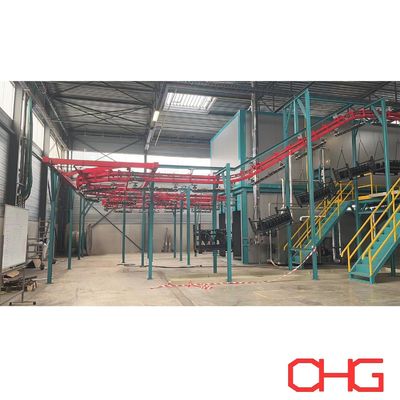
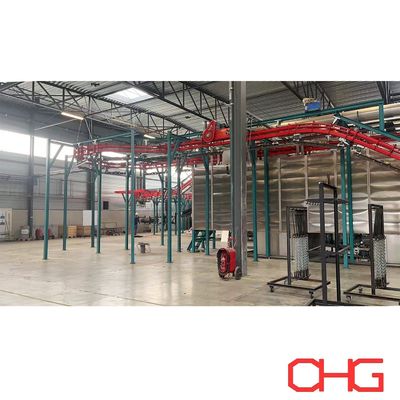
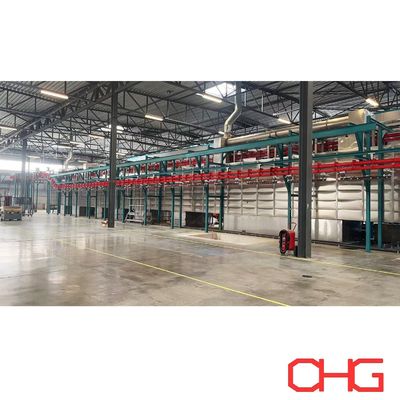
Overhead Conveyor Layout
Installing the conveyor overhead helps make efficient use of available workshop space.
The system can transport workpieces above production areas while leaving more floor space available for:
Pretreatment equipment
Spray booths
Powder recovery systems
Ovens
Operator stations
Material storage
Maintenance access
Conveyor routing can be adapted to the available factory dimensions and equipment arrangement.
Customized Carriers and Hangers
Carrier design is determined according to the actual products being transported.
Important engineering factors include:
Workpiece dimensions
Individual product weight
Number of products per carrier
Center of gravity
Hanging orientation
Required spacing
Coating accessibility
Oven clearance
Loading and unloading method
Different carriers and hangers can be developed for lightweight components, large fabricated products, or heavy industrial workpieces.
Flexible Production Routing
Where the production process requires it, a Power and Free conveyor can incorporate switches and transfer sections to create different material routes.
This can be useful when:
Different products require different coating processes
Certain workpieces need to bypass a process stage
Multiple production routes share common equipment
Buffer areas are required
Different loading or unloading stations are used
Routing requirements should be determined during the production line design stage according to the actual process flow.
Integration with Coating Equipment
The Power and Free conveyor can be integrated with different sections of a complete coating production line, including:
Spray pretreatment systems
Immersion pretreatment systems
Moisture drying ovens
Powder spray booths
Automatic powder spraying equipment
Manual touch-up stations
Liquid painting booths
Curing ovens
Cooling zones
Inspection stations
Loading and unloading areas
The conveyor layout is coordinated with the equipment arrangement to maintain suitable workpiece positioning and process timing throughout the production line.
Conveyor Control System
The conveyor can be integrated into the overall PLC and HMI control system of the coating line.
Depending on the project configuration, the control system may manage:
Carrier movement
Stop and release functions
Accumulation zones
Conveyor speed
Process routing
Equipment interlocking
Workpiece positioning
Production sequence
Fault alarms
Operating status
Sensors and detection devices can be incorporated at key positions to monitor carrier location and coordinate conveyor movement with other production equipment.
Safety and Operational Protection
A Power and Free conveyor system requires appropriate mechanical and electrical protection according to its layout and operating conditions.
Depending on the project, the system can incorporate:
Emergency stop devices
Carrier detection
Overload protection
Conveyor interlocks
Position monitoring
Mechanical guarding
Anti-collision control where required
Fault and alarm indication
Safety arrangements are determined according to the conveyor configuration, workpiece characteristics, operating environment, and applicable project requirements.
Advantages for Coating Production Lines
Typical Applications
Power and Free conveyor systems are widely applicable to industrial coating lines processing products such as:
Automotive components
Metal furniture
Electrical cabinets and enclosures
HVAC products
Machinery components
Agricultural equipment
Metal doors and frames
Storage racks and shelving
Fabricated steel structures
General industrial metal products
The system can be designed for different workpiece dimensions and loading requirements according to the specific project.
Power and Free Conveyor vs. Continuous Overhead Conveyor
|
Feature |
Power and Free Conveyor |
Continuous Overhead Conveyor |
|---|---|---|
|
Carrier Movement |
Individually controllable |
Moves continuously with chain |
|
Carrier Accumulation |
Available |
Limited |
|
Stop at Process Stations |
Possible |
Generally requires continuous movement |
|
Multiple Process Routes |
Can be configured |
Usually fixed route |
|
Production Flexibility |
High |
Suitable for simpler continuous processes |
|
System Complexity |
Higher |
Lower |
|
Typical Application |
Multi-stage or flexible production |
Stable, repetitive continuous production |
The appropriate conveyor type should be selected according to production capacity, workpiece characteristics, process timing, automation requirements, and project budget.
Customized Power and Free Conveyor Design
Power and Free conveyors are engineered according to the actual production line rather than selected as a fixed standard system.
Important design information includes:
Workpiece dimensions
Maximum workpiece weight
Products per carrier
Required production capacity
Conveyor speed requirements
Carrier spacing
Loading and unloading method
Process flow
Required accumulation positions
Factory dimensions and clear height
Equipment layout
Required routing
Automation requirements
Based on these parameters, we can develop a customized conveyor solution covering the track layout, carrier design, hanger arrangement, drive system, accumulation sections, transfer mechanisms, control system, and integration with the complete coating production line.
Contact us with your workpiece information, production requirements, and factory layout for a customized Power and Free conveyor solution.
![]()