logo

products details

Created with Pixso. Home Created with Pixso. Products Created with Pixso.
Pretreatment Line
Created with Pixso.

Comprehensive Pretreatment Line for Metal Surface Cleaning and Chemical Conditioning Prior to Powder Coating Application

Comprehensive Pretreatment Line for Metal Surface Cleaning and Chemical Conditioning Prior to Powder Coating Application

Brand Name: CHG
Model Number: PR-PSS-03
MOQ: 1 set
Price: 100,000-200,000 USD
Payment Terms: D/A,L/C,D/P,T/T
Supply Ability: 10 sets per year
Detail Information
Place of Origin:
China
Certification:
CE, ISO
Model NO.:
PR-PSS-03
Customized:
Customized
Mini Order Qty:
1 Set
Trademark:
CHG
Customization:
Available
After-sales Service:
Guide Equipment Installation And Use
Warranty:
1 Year
Packaging Details:
Varies depending on the design
Product Description

Automatic Spray Pretreatment System for Powder Coating Lines


Industrial Metal Surface Preparation Before Powder Coating

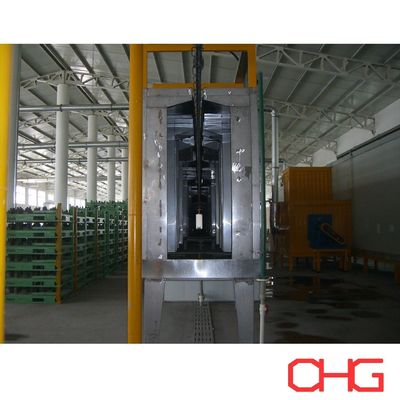
The spray pretreatment system is an essential part of a complete powder coating production line. Its primary function is to remove oil, dirt, processing residues, and other contaminants from metal workpieces while chemically preparing the substrate for subsequent powder application.

During operation, workpieces travel through enclosed treatment sections where cleaning, rinsing, and conversion-treatment solutions are applied through strategically arranged spray nozzles. A properly configured pretreatment process helps improve powder coating adhesion, corrosion protection, and overall finishing consistency.

The process sequence, treatment chemicals, number of stages, equipment dimensions, and operating parameters can be customized according to the workpiece material, surface condition, production capacity, and required coating performance.


How the Spray Pretreatment System Works

Workpieces are transported through a series of treatment zones by the production line conveyor. Pumps circulate the required process liquids from individual tanks to spray pipes and nozzles positioned around the workpieces.

Each stage performs a specific cleaning, rinsing, or chemical treatment function before the products move to the next section.

A typical process may include:

Degreasing → Water Rinsing → Conversion Treatment → Water Rinsing → Final Rinsing → Moisture Drying

Additional treatment stages can be incorporated where required by the product or coating specification.


Main Pretreatment Stages

1. Degreasing and Cleaning

The first chemical treatment removes contamination accumulated during manufacturing, machining, storage, and handling.

Typical contaminants include:

  • Oil and grease

  • Dust and dirt

  • Machining fluids

  • Fingerprints

  • Manufacturing residues

  • Other surface contamination

Cleaning solution is sprayed onto the workpieces through multiple nozzles to provide effective contact with the required surfaces.

Thorough degreasing creates a clean substrate and prepares the workpiece for subsequent chemical treatment.

2. Water Rinsing

After degreasing, the products pass through one or more rinsing sections.

The rinse stages remove residual cleaning chemicals and contaminants from the workpiece before the next treatment process.

Effective rinsing also helps:

  • Reduce chemical carryover

  • Limit contamination between process tanks

  • Maintain more stable bath conditions

  • Improve overall pretreatment consistency

Multiple rinse stages or cascade rinsing can be incorporated according to process requirements.

3. Surface Conditioning

Where required by the selected chemical process, a surface conditioning stage can be incorporated before conversion treatment.

Rather than simply increasing surface roughness, this stage is used to establish a more suitable and uniform surface condition for the subsequent conversion process.

The requirement for surface conditioning depends on the substrate material and selected pretreatment chemistry.

4. Conversion Treatment

After cleaning and rinsing, the metal surface can undergo a suitable conversion treatment to improve coating adhesion and corrosion performance.

Depending on the substrate and project requirements, treatment options may include:

  • Iron phosphating

  • Zinc phosphating

  • Other conversion coating processes

  • Passivation where required

The exact chemical process should be selected according to the workpiece material, required corrosion resistance, powder coating specification, and applicable quality standards.

5. Final Rinsing

Following conversion treatment, additional rinsing removes unwanted chemical residues before drying.

The final rinse configuration can be designed according to the selected chemical process and required surface quality.

Where necessary, purified or deionized water can also be incorporated into the final rinsing stages.

6. Moisture Drying

Before entering the powder spray booth, residual water must be removed from the treated workpieces.

The drying section provides controlled heating to ensure that the products reach the powder application stage with sufficiently dry surfaces.

Proper moisture removal helps reduce coating defects and provides stable conditions for electrostatic powder spraying.


Spray Circulation System

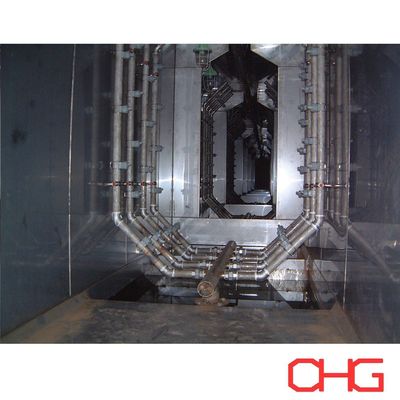
Efficient liquid circulation is an important part of the pretreatment equipment.

Each process stage can incorporate components such as:

  • Process tanks

  • Circulation pumps

  • Spray pipes

  • Spray nozzles

  • Filters

  • Heating equipment

  • Liquid-level control

  • Piping and valves

The spray nozzle arrangement is designed according to workpiece dimensions and geometry to provide effective treatment coverage.

Pump capacity, spray pressure, nozzle quantity, and pipe arrangement are selected according to the actual process requirements rather than using a fixed standard configuration.


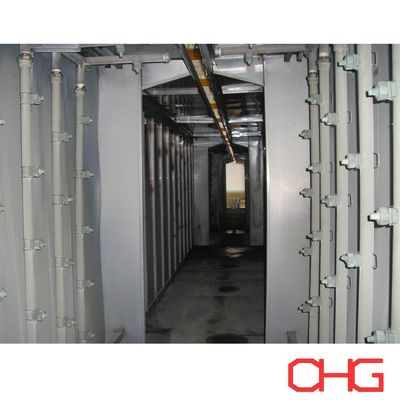
Enclosed Pretreatment Tunnel

The spray treatment sections are typically enclosed within a pretreatment tunnel to contain spray liquids and separate individual chemical processes.

The tunnel and process tanks can be manufactured from suitable corrosion-resistant materials according to the chemicals used in each treatment stage.

Equipment design can incorporate:

  • Access doors

  • Inspection areas

  • Drainage arrangements

  • Mist containment

  • Maintenance access

  • Separation between treatment zones

The overall tunnel length is determined by conveyor speed, required treatment time, number of process stages, and workpiece dimensions.


Automatic Process Control

The pretreatment system can be integrated with the production line's PLC and HMI control system.

Depending on project requirements, the system can control or monitor:

  • Bath temperature

  • Pump operation

  • Spray pressure

  • Liquid level

  • Heating equipment

  • Conveyor operation

  • Process sequence

  • Equipment status

  • Alarm conditions

Chemical concentration can also be monitored or managed using appropriate instruments and chemical dosing systems where required.

Centralized control helps maintain repeatable operating conditions and simplifies production management.


Main Advantages

  • Efficient Surface Cleaning: High-pressure circulation and properly arranged spray nozzles provide effective cleaning and chemical treatment for continuously conveyed metal components.
  • Consistent Pretreatment Quality: Controlled process conditions help maintain repeatable surface preparation before powder application.
  • Improved Coating Adhesion: Removing contamination and applying the appropriate conversion treatment creates a suitable substrate for subsequent powder coating.
  • Enhanced Corrosion Protection: A correctly selected pretreatment process can significantly contribute to the corrosion resistance of the complete coating system.
  • Continuous Production: Spray pretreatment integrates easily with conveyorized powder coating lines, allowing workpieces to move continuously from surface treatment to drying and powder application.
  • Flexible Process Configuration: The number of treatment stages, chemical processes, tunnel dimensions, spray system, and automation level can all be adapted to the specific application.

Typical Applications

Spray pretreatment systems can be used for a wide variety of industrial metal products, including:

  • Automotive components

  • Electrical cabinets and enclosures

  • Metal furniture

  • Storage racks and shelving

  • HVAC components

  • Machinery parts

  • Agricultural equipment

  • Metal doors and frames

  • Fabricated steel products

  • General industrial metal components

Different process configurations can be developed for steel, galvanized steel, aluminum, and other suitable substrates.


Customized Spray Pretreatment Solutions

Each pretreatment system is engineered according to the customer's products and required coating performance.

Important information for system design includes:

  • Workpiece material

  • Maximum dimensions and weight

  • Surface condition before treatment

  • Required production capacity

  • Conveyor speed

  • Required corrosion performance

  • Pretreatment chemical process

  • Available factory dimensions

  • Water quality and supply conditions

  • Heating energy source

  • Wastewater treatment requirements

  • Required automation level

Based on these parameters, we can develop a customized solution covering the pretreatment process, spray tunnel, process tanks, circulation pumps, nozzle arrangement, heating system, moisture drying section, control system, and integration with the complete powder coating line.

Contact us with your workpiece and production information for a customized spray pretreatment system proposal.


Metal Surface Pretreatment Equipment Spray System for Powder Coating Production Line Metal Surface Pretreatment Equipment Spray System for Powder Coating Production Line