|
|
| Brand Name: | CHG |
| Model Number: | AC-20 |
| MOQ: | 1 set |
| Price: | 100,000-300,000 USD |
| Payment Terms: | L/C,D/A,D/P,T/T |
| Supply Ability: | 10 sets per year |
Automatic Powder Coating Production Line with Power and Free Conveyor
Flexible Industrial Coating Solution for Various Metal Components
This automatic powder coating production line is designed for metal components with different dimensions, shapes, and structural characteristics. The system combines automated powder application with flexible material handling to provide stable coating quality and efficient production for a wide range of industrial products.
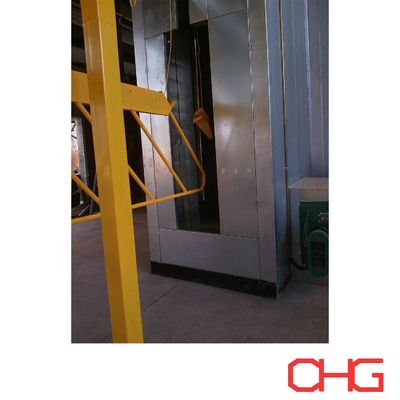
The powder spray booth is constructed from durable PVC material, providing good chemical resistance and reliable performance in industrial coating environments.
For powder application, automatic electrostatic spray guns are combined with manual touch-up stations. Automatic spraying handles the primary coating operation, while manual spraying provides additional coverage for corners, recessed areas, and complex workpiece geometries.
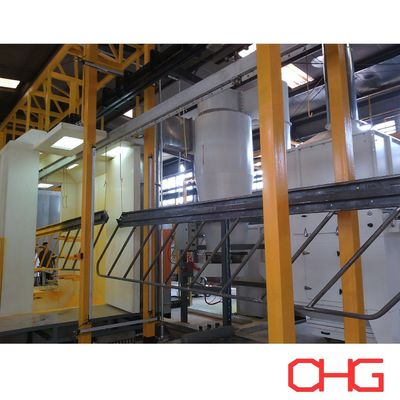
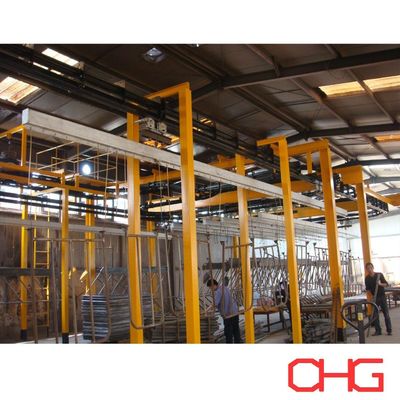
The line adopts a Power and Free overhead conveyor system, while loading and unloading are performed manually. This configuration provides a practical balance between automation, production flexibility, and efficient workpiece handling.
Main Features
Suitable for metal parts of various sizes and shapes
PVC powder spray booth
Automatic electrostatic powder application
Supplementary manual touch-up spraying
Power and Free overhead conveyor
Manual loading and unloading
Flexible production arrangement
Customized engineering according to workpiece requirements
Automatic and Manual Powder Spraying
The spraying section combines automatic spray guns with manual coating capability.
Automatic spraying provides repeatable powder application on the main workpiece surfaces, helping improve production efficiency and coating consistency.
For components with complicated structures, operators can perform manual touch-up spraying on areas such as:
Corners and edges
Recessed sections
Welded areas
Irregular surfaces
Difficult-to-reach locations
This hybrid configuration allows the production line to process a wider variety of products while maintaining stable finishing quality.
PVC Powder Spray Booth
The powder booth uses a PVC structure designed for industrial powder coating applications.
The booth configuration can be engineered according to:
Maximum workpiece dimensions
Number of automatic spray guns
Manual spraying requirements
Conveyor arrangement
Powder recovery method
Required production capacity
The extraction and recovery systems work together with the booth to maintain an appropriate spraying environment and collect oversprayed powder.
Power and Free Overhead Conveyor
The production line uses a Power and Free conveyor to transport workpieces through different process sections.
Unlike a conventional continuously moving conveyor, a Power and Free system provides greater flexibility in controlling carrier movement and production flow.
Depending on the process design, carriers can be:
Transported between production stages
Stopped at designated positions
Accumulated when necessary
Released according to process requirements
This flexibility is particularly useful when different processing sections require different operating times.
Conveyor routing, carrier spacing, hanger design, loading capacity, and operating speed are customized according to the actual workpieces and production requirements.
Manual Loading and Unloading
Workpieces are manually loaded onto and removed from the conveyor system at designated stations.
Manual handling provides greater adaptability when the production line processes components with different dimensions, shapes, or hanging requirements.
Suitable hangers and fixtures can be designed according to product geometry to ensure stable transportation and appropriate positioning during powder spraying and curing.
Powder Coating Process Flow
A typical powder coating production line consists of the following major stages:
Surface Preparation → Pretreatment → Drying → Powder Spraying → Curing → Cooling → Quality Inspection
1. Surface Preparation
Before chemical pretreatment and powder application, metal workpieces must be properly cleaned.
The purpose of surface preparation is to remove contaminants such as:
Oil
Grease
Dust
Dirt
Processing residues
Other surface contamination
A clean substrate provides a reliable foundation for subsequent pretreatment and coating processes.
2. Pretreatment
After initial cleaning, the workpieces undergo a suitable chemical pretreatment process.
The specific process is selected according to the substrate material, surface condition, and required corrosion performance.
Typical stages may include:
Degreasing
Water rinsing
Surface conditioning
Phosphating or other conversion treatment
Final rinsing
Proper pretreatment helps improve coating adhesion and enhances the corrosion resistance of the finished coating system.
3. Drying
Following pretreatment, residual moisture is removed before powder spraying.
The workpieces pass through a drying section where controlled heating provides a sufficiently dry surface for electrostatic powder application.
Proper drying helps prevent moisture-related coating defects and contributes to consistent finishing quality.
4. Electrostatic Powder Application
The prepared workpieces enter the powder spray booth.
Powder particles are electrostatically charged by the spray guns and attracted to the grounded metal workpieces, forming an even powder layer over the required surfaces.
Automatic guns perform the main spraying operation, while manual touch-up can be used where additional coverage is necessary.
The combined spraying system provides:
Consistent powder distribution
Stable coating thickness
Efficient application
Improved coverage of complex components
Flexible handling of different products
5. Powder Curing
After powder application, the coated workpieces are transported into the curing oven.
Under controlled heating conditions, the powder coating melts, flows, and chemically cross-links to form a continuous and durable coating film.
Curing parameters are determined according to factors such as:
Powder specification
Workpiece material
Metal thickness
Product geometry
Required coating performance
Correct curing is essential for achieving the required appearance and mechanical properties of the finished coating.
6. Cooling
After leaving the curing oven, coated components enter the cooling stage.
The workpieces are cooled sufficiently to stabilize the coating and allow safe handling during inspection and unloading.
7. Quality Inspection
Finished components undergo inspection according to the required coating specifications.
Typical inspection items include:
Coating thickness
Surface appearance
Coating uniformity
Adhesion
Color and gloss
Visible coating defects
Qualified products can then proceed to unloading, assembly, packaging, or subsequent manufacturing processes.
Customized Powder Coating Line Design
Every powder coating project has different requirements. Our production lines are therefore engineered according to the customer's actual products, required output, coating specifications, and available factory conditions.
Important information for developing a technical proposal includes:
Workpiece material
Maximum product dimensions
Maximum workpiece weight
Required production capacity
Product drawings or photographs
Pretreatment requirements
Coating performance requirements
Number of colors and color-change frequency
Factory layout and available space
Available energy sources
Required automation level
Based on these parameters, we can develop a customized solution covering the pretreatment system, Power and Free conveyor, PVC spray booth, powder application equipment, curing system, and overall production line layout.
Contact us with your product specifications and production requirements for a customized powder coating line proposal and quotation.